
When Hieronymus Bosch painted The Garden of Earthly Delights at the turn of the 16th century, he didn’t offer viewers a clear message—he offered them a world to get lost inside.
Panels unfold like dreams you can’t quite explain: a paradise that feels slightly off, a middle world teeming with indulgence and strange delight, and a final descent into something darker, more unsettling. Even now, centuries later, the painting resists resolution. You don’t simply look at Bosch—you wander through him.
That may be why his work continues to feel so immediate. In an age that often favors clarity, Bosch reminds us of the power of ambiguity—of images that invite questions rather than answers.
A Mind That Painted in Symbols
Bosch’s visual language is unmistakable. Hybrid creatures drift between the familiar and the absurd. Everyday objects take on ritualistic weight. Human figures move through scenes that feel at once playful and ominous.
Unlike many of his contemporaries, who sought to bring order and proportion to the visible world, Bosch seemed more interested in what lies beneath it—the fears, temptations, and quiet contradictions of human life.
Take The Haywain, for instance. At first glance, it appears almost theatrical: a procession, a landscape, a gathering of figures. But linger a little longer, and the meaning begins to shift. The hay becomes more than hay—it becomes a symbol of earthly desire, something pursued, fought over, and ultimately fleeting.
It’s this density of meaning that makes Bosch’s work feel less like an image and more like a puzzle already waiting to be solved.
From Painted Panel to Wooden Form
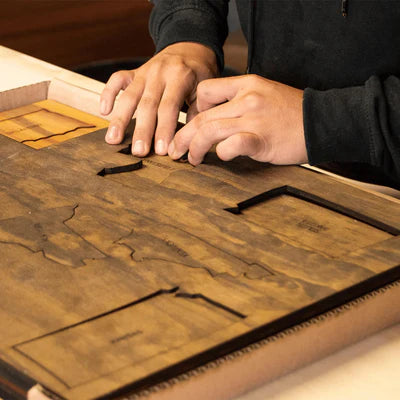
Translating a work like The Haywain into a wooden puzzle doesn’t simplify it—it deepens the experience.
Where a screen invites a glance, wood asks for attention. Grain catches the light differently across each piece. Shapes resist predictability. The image reveals itself slowly, section by section, as if echoing the way Bosch constructed meaning in layers.
There’s a quiet satisfaction in this process—not just in finishing the image, but in noticing what you might have otherwise missed. A small figure tucked into a corner. A gesture that suddenly feels significant. A detail that shifts the tone of the entire scene.
What was once overwhelming becomes intimate.
The Pleasure of Slowing Down
There’s something almost ritualistic about sitting down with a puzzle like this.
An evening stretches out. The noise of the day softens. Piece by piece, the world narrows—not in a limiting way, but in a focusing one. Attention returns to the hands, to the eyes, to the act of seeing carefully.
Bosch’s work, with all its intricacy and unpredictability, rewards this kind of attention. It meets you at the pace you’re willing to give it.
And in return, it offers something increasingly rare: sustained engagement.
A Thoughtful Object, Not Just a Gift
For someone drawn to art, history, or simply meaningful objects, a piece like this carries a different kind of weight.
It isn’t just something to complete—it’s something to return to. To display. To revisit. To share.
It suits the person who lingers in galleries, who reads the placards, who notices the details others pass by. The kind of person who doesn’t mind taking their time.
An Invitation to Experience It Differently
Some artworks ask to be viewed. Others ask to be lived with.
Bosch belongs firmly in the second category.
To piece together one of his works is not to solve it, but to spend time inside it—to notice, to question, to return again to the details that first caught your eye.
If you find yourself drawn to images that reveal more the longer you stay with them, this is one worth experiencing beyond the frame.
Explore our handpicked selection and turn art history into an interactive narrative with puzzles that celebrate cultural depth and craftsmanship.