In the shifting tapestries of medieval Europe, two artists emerge as masterful weavers of the human experience. Their creations, like whispers from the past, beckon us to pause and ponder. Hieronymus Bosch and Pieter Bruegel the Elder are both painters whose names echo across the corridors of art history, inviting us to explore the curiosities and complexities of their worlds.
Their canvases breathe with vivid allegories and vibrant narratives. Yet, to truly understand the riddle wrapped within the canvas, the gentle labyrinth of a wooden puzzle serves as a fitting complement—a journey reminiscent of earlier epochs when contemplation and craft were one.
A Brush with the Past: Bosch and Bruegel in Context
Born out of the tumult and religious fervor of the Northern Renaissance, both artists articulated the anxieties and aspirations of their time, albeit with distinct voices. Hieronymus Bosch's paintings, like "The Garden of Earthly Delights" and "The Temptation of Saint Anthony," available in exquisite puzzle form, are enigmatic parables, haunted by surreal, nightmarish creatures that challenge the viewer's perception of morality and mortality. Bosch, with his unparalleled imagination, creates a world teeming with symbolic nuances—sometimes grotesque, always profound.
Pieter Bruegel, on the other hand, leans towards an anthropological lens. His landscapes and peasant scenes, such as those found in "Children's Games" captured in precisely-cut jigsaw pieces, ground their allegorical weight in the mundane, portraying the ordinary with an affectionate eye that makes folly seem universal and timeless.
The Everlasting Echo: Why Their Art Matters Today
History pivots, yet the truths they conveyed remain unassailably current. Bosch's art mirrors the modern struggle between utopia and dystopia, questioning societal norms just as fervently now as in the 16th century. Bruegel's equitable observations transcend time, inviting modern viewers to laugh at the constancy of human nature and our unbroken line of civic mischief.
The allure of their work is not merely intellectual but tactile. Rendering these masterworks into carefully crafted wooden puzzles offers a tangible connection between viewer and artist. As each piece of Bosch’s "The Temptation of Saint Anthony" slots into place, the bridge from past conundrum to present resolution is polished, held, and understood.
Craft and Affection: The Image in a New Medium
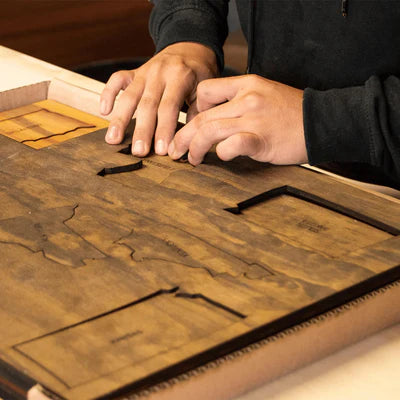
What alchemy transforms a painting into a wooden symphony? Crafted by storytellers, these puzzles are not mere replicas—they are reinterpretations, where the lucidity of Bosch's fantastical realms and Bruegel’s festivity find new expressions under rigorous, direct UV printing on 2.5 mm thick MDF. Each section, touched by craftsmanship and passion, becomes a panel in an enduring narrative, stretching beyond the canvas into the fingertips of the present.
The Ritual of Puzzling: A Mindful Escape
Engage in the careful ritual of assembling these fragmented worlds; it is not merely time lost or found but a meditative meandering through art and thought. The methodical nature of this task slows the clock, favoring introspection and reiterating an ancient relationship between man, craft, and spectacle.
Gift of Discovery: A Treasure for the Art-Inclined
For those who value more than material possessions, a wooden jigsaw captures the essence of a thoughtful, multidimensional gift for connoisseurs of art and history. Like the paintings themselves, their puzzle forms are collectible treasures, inviting wonder, introspection, and joy. Pieter Bruegel and the History of the Imagination extends this journey into textual exploration.
An Invitation to Embrace the Canvas of the Mind
Within the wooden belly of a puzzle box lies anticipation, patience, and discovery—a gentle query if you might wish to embark on a journey of yesterday as led by the hands of Bosch and Bruegel. Stepping into their world, through a gift or a personal pursuit, becomes an act of homage to the artistry that spans centuries, waiting to be embraced anew: https://www.whatawoodwork.com.
In the intermingling of past reveries with present touch, their art endures—an everlasting dance of color, shadow, and form.