
A gaunt specter emerges from the bleeding ink of a master's brush, its haunting face twisted in grotesque delight as it lunges forward. The edges blur into ethereal smoke, leaving an unsettling trace on the canvas of the mind. Nearby, a samurai's blade gleams, glancing off ambient moonlight as it stands ready. This is the world of Kawanabe Kyosai, a visionary of the damned and divine, capturing in stark clarity the volatile dance between daimyo and demons.
Steeped in the rich tradition of Edo and Meiji periods, Kyosai's works navigate the realms of musha-e and yokai-ga. These narratives, suspended in time, draw heavily on the ukiyo-e woodblock print tradition, a lineage defined by its meticulous use of pigment and the choreographed dance of impression. Kyosai, a maverick in his own right, would often collaborate with publishers to deliver pieces where even the smallest seal could tell a story whispered through centuries.
Kyosai's legacy thrives on the interplay of the timeless. His works speak to the themes of honor and fear, the supernatural realm and the inescapable grip of mortality. Scholars and collectors revel in the visual and psychological depth of his prints, each layer of pigment reminding them of mono no aware—the poignant beauty of transient beauty. There exists an irrepressible yugen, a profound grace that can only be felt, never fully captured.
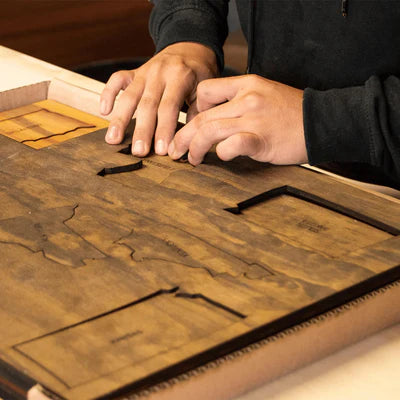
When translated into wood, Kyosai's bold linework and dynamic contrasts become a tactile exploration. Each puzzle piece, precision-crafted from premium wood, bears the weight of its origins. The grain deepens the carved ink, enhancing the visual narrative with a tangible presence. This is no ordinary pastime, but a scholarly engagement with history—a work that demands patience and invites meditation.
The ritual of piecing together a wooden jigsaw puzzle transforms the viewer into a participant of Kyosai's tableau. Piece by piece, a yokai's face emerges, or perhaps it's Hokusai's iconic wave, cresting from calm to chaos. The reconstruction is deliberate, each interlocking shape a mindful step in a dance with the past. It is a pursuit akin to meditation, and when completed, it's not just a puzzle but a ritual object.
For those who cherish Japanese mythology and the story-laden histories of samurai and spirits, these puzzles offer more than their sum. They are heirlooms, fit for collectors who recognise the eternal allure of these narratives. A puzzle like Shoki the Demon Queller — Kawanabe Kyosai Wooden Puzzle allows aficionados to frame and embrace the art form as a centerpiece of cultural admiration.
As the pieces fall into place, consider exploring our curation of Japanese art within the collection at Japanese Art.
In this quiet culmination, let the silent dialogues of daimyos and demons echo through your space, grounding you in a narrative as compelling today as when it first danced across the artist's canvas.