
A vivid slice of time: a warrior's determined grimace as he deftly handles his blade, the edges of his kimono flowing like water. The shadows beneath the furrowed brow hint at battles fought and yet to come. As the sword's edge catches a beam of moonlight, the world seems suspended in a silent, poised tension, captured eternally on a slab of wood.
Within the realm of Edo period artistry, the woodblock print revolutionized visual storytelling. Utagawa Kuniyoshi, among its most celebrated artists, breathed life into the musha-e, the warrior prints that brought fame to both samurai and artist. The layered pigments of his works, produced at the twilight of the Edo period, capture moments frozen in wood and ink. They are a profound exploration of the complexities of life and the traditions they celebrate. Traditional publisher seals bear witness to these impressions, marking authenticity in an era where such art was akin to capturing the spirit.
What elevates these works beyond mere historical artifacts is their encapsulation of mono no aware, that ineffable poignancy of things. Kuniyoshi's depictions of honor and mortality resonate across the shifting centuries, narrating the universal cycle of struggle and fleeting triumph. Scholars and collectors alike find in this art the timeless threads of human experience—fear and bravery, the supernatural and the mortal—woven deftly within bold outlines and exquisite details.
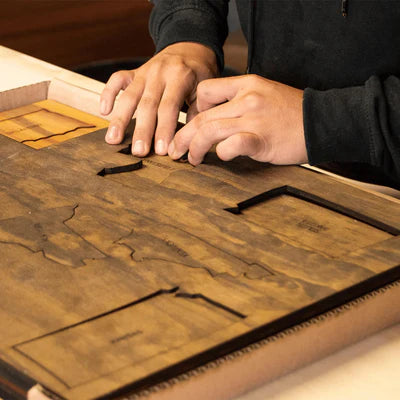
Transforming these resonant images into wooden jigsaw puzzles respects the profound beauty of their craft. Each piece, a bold linework expression, gains a new dimension from the natural grain of premium wood. The act of assembling evolves into a scholarly pursuit, where each piece once held by the carver's hand is a testament to creative decisions shaped by centuries-old traditions.
When one sits to reconstruct the ensnaring gaze of a yokai or the calm before Hokusai's chaotic wave, the ritual becomes a meditation. It is a return to an undeviating calm, where piece by piece, the essence of Edo mastery is reified. The puzzle is not merely a temporal pastime, but a dialogue with history and art, allowing the soul to linger in the quiet passages of mono no aware.
For devotees of Japanese heritage, mythology enthusiasts, and history collectors, these puzzles are not mere trinkets but heirloom pieces—a cultured addition to any serious collection. Gifting such an object provides a bridge across time, a refined nod to a profound tradition. In the choice of gifting, one offers an experience both introspective and enlightening, without the echo of urgency.
In the stillness of a room softly lit, the image stands completed upon your table, a mosaic of Edo melancholia woven through your fingertips. As you reflect on your connection to the past, the serene containment of artistry, remember that these legends are yours to cherish. Explore them further at Japanese Art Collection.
To discover the works of Utagawa Kuniyoshi and Kawanabe Kyosai transformed into premium wooden puzzles, visit:
- Utagawa Kuniyoshi Wooden Puzzle | Samurai Kamada | Japanese Art Jigsaw Puzzle
- Shoki the Demon Queller — Kawanabe Kyosai Wooden Puzzle
- Funny Spirits of Old Japan — Vintage Yokai Woodblock Puzzle
Delve deeper into these intricate worlds and let history's whispers form a tapestry upon your living room floor.