


Fly Agaric Wooden Puzzle — Amanita muscaria 1892
Fly Agaric Wooden Puzzle — Amanita muscaria 1892
- Regular price
- Price: $115.00
- Regular price
- List Price: $0.00
- Sale price
- Price: $115.00
- Unit price
- per
Key Features:
Key Features:
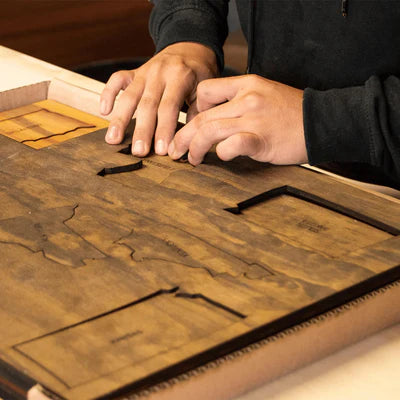
- Premium Quality: Crafted from durable 3mm (.14in) composite wood board for lasting enjoyment.
- Vibrant Imagery: High-resolution UV printing directly on the wood—no paper laminate—for stunning detail and vibrant colors.
- Eco-Conscious: Made with environmentally friendly materials.
- Heirloom Keepsake: Your puzzle arrives beautifully packaged in a handcrafted wooden box, perfect for gifting or storing your masterpiece.
Craftsmanship and Care:
Craftsmanship and Care:
Experience the satisfying click of perfectly interlocking pieces. Our state-of-the-art laser cutting ensures precise fit and a smooth, seamless puzzle-solving experience. The perfect upgrade from cardboard without breaking the bank.
- Natural Laser Residue: A small amount of harmless black residue from the laser cutting process may be present. Simply wipe it away with a damp cloth.
- Hand-Finished Details: Each puzzle board, each wooden box are all carefully hand-stained, painted, and glued.
Satisfaction Guaranteed:
Satisfaction Guaranteed:
We are confident in the quality of our puzzles. If you are not completely satisfied, we offer a full refund or exchange.
PLEASE NOTE:
Each puzzle is crafted to make the most of your chosen size. Artwork may be subtly adjusted to meet our material and production standards while honoring the original work. Planning to frame yours? Email info@whatawoodwork.com for final measurements.
Couldn't load pickup availability
In stock
 PRODUCT DESCRIPTION
Someone painted the Fly Agaric in Leigh Woods in September 1892 and never signed it.
The inscription names the place and the Latin binomial — the older classification, Agaricus muscarius, not yet replaced by Amanita muscaria — but not the painter. Scholars think it was probably a Bristol art student on a field study. The Wellcome Collection has held it ever since, catalogued and largely unseen.
📖 The Story Behind This Piece
Painted in September 1892, this watercolour shows two stages of the Fly Agaric caught at close range in Leigh Woods, a stretch of ancient woodland on the west bank of the Avon Gorge near Bristol. The mature specimen fills the foreground: red cap, white remnant spots, gills just visible beneath. Beside it, a younger button stage sits tight and enclosed, not yet opened. The two together are a single organism shown across time — the Victorian naturalist's way of turning a painting into an argument about process, not just appearance.
No name appears beneath the inscription. The artist knew the old Latin name for the fungus, knew the location precisely enough to record it, and handled watercolour with enough confidence to leave the white spots as bare paper rather than painting over them in white. That last choice is a trained one. Whoever held the brush understood the medium. The anonymity was probably circumstantial, not chosen — a student's field study, submitted and forgotten, surviving only because the Wellcome Collection catalogued everything.
When assembling the cap of the mature specimen, the puzzle surface does something a screen can't replicate. UV printing on wood gives the red a slight warmth — closer to pigment on paper than to backlit colour — and the white spots, which in the original are reserved bare watercolour paper, read as genuinely pale rather than bleached. The transition from the deep, shadowed underside of the cap to the bright upper surface breaks across dozens of pieces with near-identical hue values. You sort by shape first, not colour. At that point you start working the way the painter worked: edge by edge, rather than by area.
🎁 Who Gets One of These
✔️ The botanical illustration collector — You already have Redouté prints on the wall. A 19th-century Wellcome Collection watercolour of a poisonous fungus, painted in the field by someone who knew their Latin, fits that shelf exactly.
✔️ The mycology enthusiast who takes it seriously — You know the difference between Agaricus muscarius and Amanita muscaria and why the older name matters. So did the person who painted this in 1892.
✔️ The puzzle buyer who has run out of interesting images — You've finished the Van Goghs and the world maps. A Wellcome Collection field study from an anonymous Victorian painter in the Avon Gorge is harder to find on a puzzle than it should be.
✔️ The person who spends autumn weekends in the woods — Leigh Woods still exists. It now hosts over 300 species of fungi in autumn. The painting is 130 years old and the subject matter hasn't changed.
✔️ The gift-giver who wants something the recipient won't already own — Most people with an interest in botanical art or natural history have never seen this piece. The Wellcome Collection holds thousands of works that rarely circulate. Finding one made into a puzzle is the point.
Strong occasion fits: autumn birthdays for anyone with a serious interest in natural history or botanical art, Christmas for the person who reads field guides for pleasure, a considered gift for someone who just joined a mycological society or naturalist group.
💎 Why This Puzzle Lasts
Most wooden puzzle makers charge $300 to $500. The craft justifies it. We get there differently: direct manufacturing, no wholesale chain, made to order only. Same materials. No markup passed to you.
The 3mm MDF core is the reason a piece clicked flat in 2025 will click flat in 2045. Cardboard absorbs humidity and bends; MDF doesn't. You notice it immediately when you pick up a piece — there's a rigidity that makes the fit feel definitive rather than approximate. UV printing goes directly onto that wood surface with no paper laminate between the ink and the core. Nothing peels, nothing lifts at the corners after a few years of storage. The colour of the red cap in 1892 is the colour you get today.
The laser-cut traditional grid means the pieces have consistent geometry — no novelty shapes, no arbitrary interlocks. When a piece fits, it seats cleanly and stays. The wooden keepsake box is built to the same standard as the puzzle itself; it doesn't get discarded after assembly. Most people keep it on a shelf near wherever the finished puzzle ends up. Production starts when you order, not before. The wait is 3 to 4 weeks because your puzzle doesn't exist yet when you buy it.
Agaricus muscarius was painted once, by someone who walked into Leigh Woods in September with a sketchbook and knew exactly what they were looking at. The painting survived 130 years in a collection. The puzzle is how it gets out of the archive.