


American Gothic by Grant Wood - Premium Wooden Puzzle
American Gothic by Grant Wood - Premium Wooden Puzzle
- Regular price
- Price: $115.00
- Regular price
- List Price: $0.00
- Sale price
- Price: $115.00
- Unit price
- per
Key Features:
Key Features:
- Premium Quality: Crafted from durable 3mm (.14in) composite wood board for lasting enjoyment.
- Vibrant Imagery: High-resolution UV printing directly on the wood—no paper laminate—for stunning detail and vibrant colors.
- Eco-Conscious: Made with environmentally friendly materials.
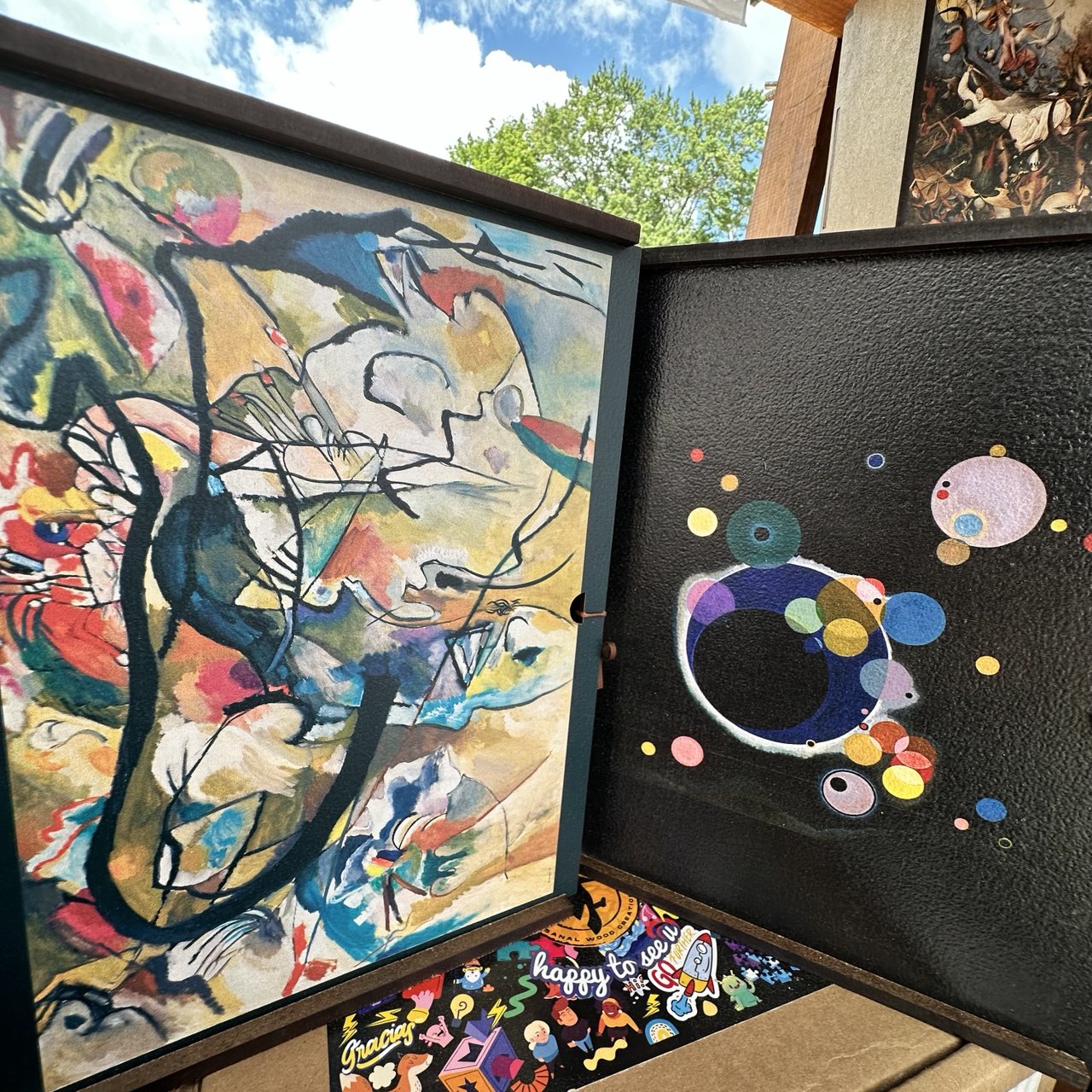
- Heirloom Keepsake: Your puzzle arrives beautifully packaged in a handcrafted wooden box, perfect for gifting or storing your masterpiece.
Craftsmanship and Care:
Craftsmanship and Care:
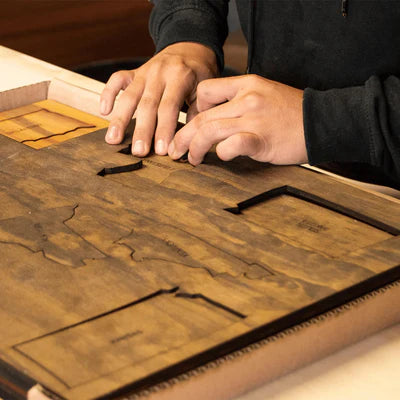
Experience the satisfying click of perfectly interlocking pieces. Our state-of-the-art laser cutting ensures precise fit and a smooth, seamless puzzle-solving experience. The perfect upgrade from cardboard without breaking the bank.
- Natural Laser Residue: A small amount of harmless black residue from the laser cutting process may be present. Simply wipe it away with a damp cloth.
- Hand-Finished Details: Each puzzle board, each wooden box are all carefully hand-stained, painted, and glued.
Satisfaction Guaranteed:
Satisfaction Guaranteed:
We are confident in the quality of our puzzles. If you are not completely satisfied, we offer a full refund or exchange.
PLEASE NOTE:
Each puzzle is crafted to make the most of your chosen size. Artwork may be subtly adjusted to meet our material and production standards while honoring the original work. Planning to frame yours? Email info@whatawoodwork.com for final measurements.
Couldn't load pickup availability
In stock
 PRODUCT DESCRIPTION
American Gothic — Wooden Jigsaw Puzzle
Grant Wood used his sister and his dentist as models. Nan Wood Graham spent decades afterward defending the painting to people who thought it mocked her. She insisted it was a tribute. Wood never fully clarified which reading he intended, and the Art Institute of Chicago acquired it anyway, the same year it was painted.
📖 The Story Behind This Piece
Wood finished American Gothic in 1930, the year after the stock market collapsed. The Carpenter Gothic house in Eldon, Iowa was real — Wood spotted it on a drive and sketched it on the back of an envelope. The two figures standing before it are not a married couple, as most people assume. They are father and daughter. The pitchfork, the severe parting of the hair, the cameo brooch at her collar — every object was chosen with the precision of a Northern Renaissance still life, a tradition Wood had studied closely during a trip to Munich the decade before.
Wood grew up on a farm outside Anamosa, Iowa, and left for art school, then Paris, then came back. The return mattered. American Regionalism, the movement he helped define, was a deliberate rejection of European abstraction in favor of the specific and local: this field, this house, these people. The detail that reframes everything is that his neighbors in Iowa initially hated the painting. They thought he was ridiculing them. He thought he was honoring them. Both readings are still alive in the image.
When you work through the center of this puzzle, the faces arrive in sections. The man's glasses are two small ovals of reflected light against a weathered face — easy to place because of the contrast, hard to place because there are only a few pieces and each one matters. UV printing on wood deepens the ochre tones of the house siding in a way that a screen flattens out. The grain of the MDF reads almost like the grain of the painted wood behind the figures. You notice that Wood gave the background nearly as much attention as the faces.
🎁 Who Gets One of These
A few specific kinds of people keep buying this one.
✔️ The art history reader who owns at least one book about the Depression era — American Gothic landed at the Art Institute in 1930 and never left. You know why that matters, and you want the real thing on your table.
✔️ The Midwesterner who grew up with this image on a wall somewhere — A grandparent's kitchen, a civics textbook, a museum field trip in fourth grade. Rebuilding it from scratch is a different relationship with a familiar picture.
✔️ The collector who frames puzzles — UV on wood holds color without a glass layer to wash it out. American Gothic's muted palette stays muted, the way Wood mixed it.
✔️ The person shopping for someone who has everything — Nan Wood Graham was still giving interviews about this painting in the 1980s. There is more story here than fits on a gift card, which makes it a good conversation to hand someone.
✔️ The museum member who visits the Art Institute regularly — You have walked past the original. Spending time with a high-fidelity reproduction built from wood is a different kind of looking.
Works well as a gift for milestone birthdays, especially for anyone with Midwestern roots or an interest in American art history. A strong holiday gift for the person on your list who reads about art rather than just decorating with it.
🧩 Puzzle Specifications
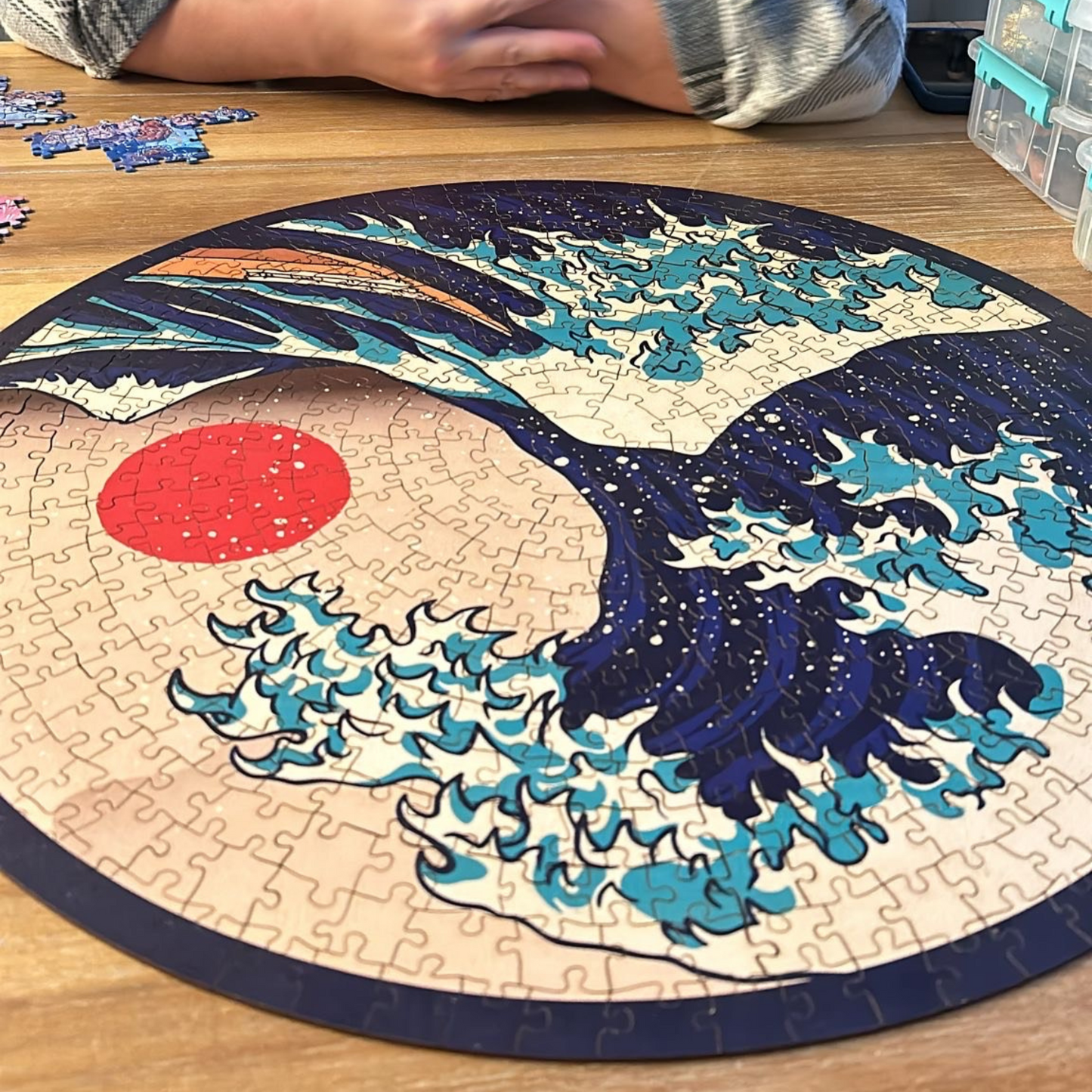
✔️ Precision laser-cut wooden pieces
✔️ 3mm MDF core — rigid, warp-resistant, built to last
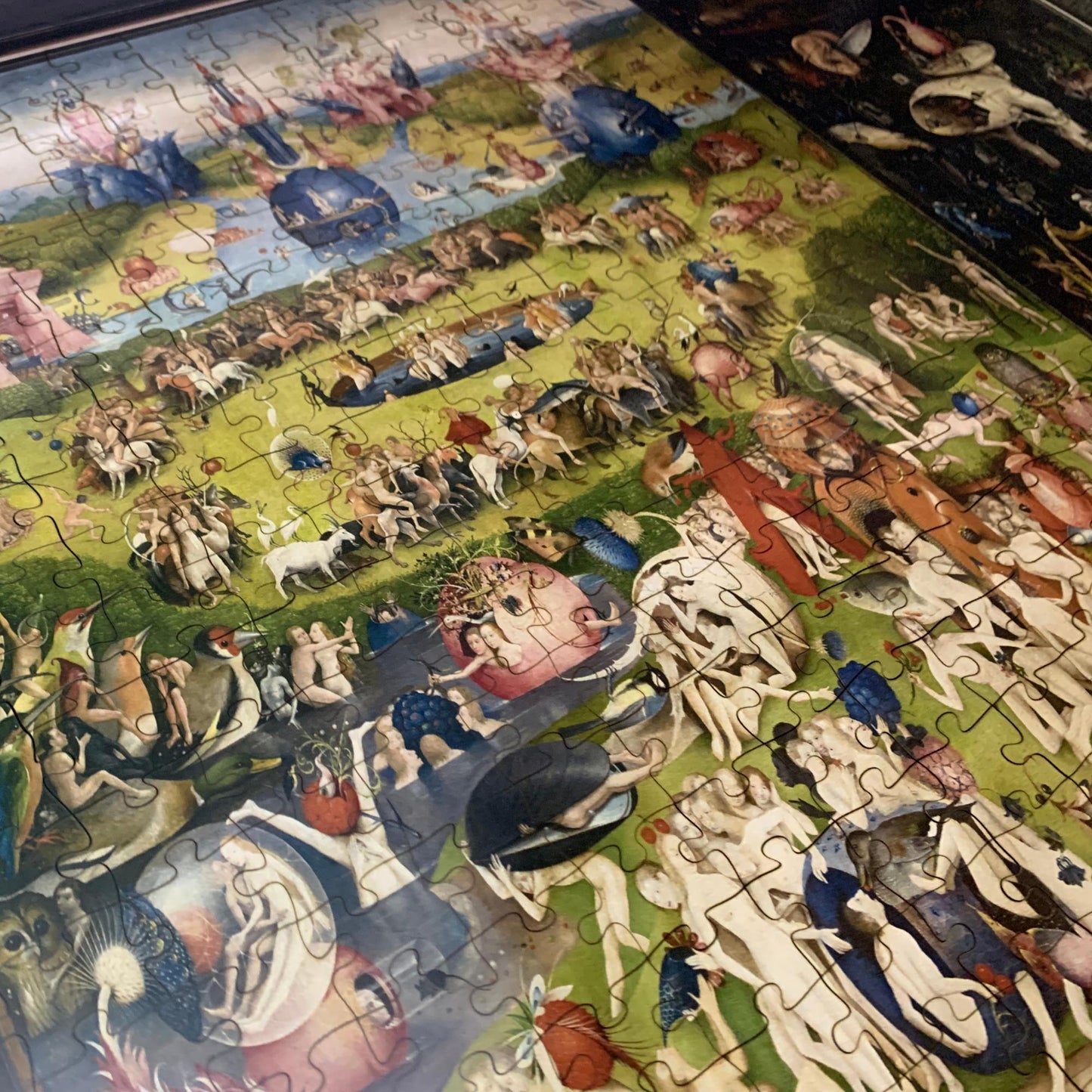
✔️ UV printing directly on wood — no paper laminate, no peeling
✔️ Traditional grid-cut design
✔️ Sizes: 15"x23", 18"x24", 23"x31"
✔️ Piece counts: 300–1000
✔️ Handcrafted wooden keepsake box included
✔️ Made to order — ships in 3–4 weeks
💎 Why This Puzzle Lasts
Most wooden puzzle makers charge $300 to $500. The craft justifies it. WAWW gets to the same place differently: direct manufacturing, no wholesale chain, no retail margin layered on top. Made to order means no warehouse, no overstock, no discounting. Same materials. The savings land with you.
The 3mm MDF core is what separates a puzzle you keep from one you recycle. Cardboard warps with humidity, and the pieces stop fitting cleanly after a few assemblies. MDF holds its shape and its tolerance. A piece placed correctly in year one clicks the same way in year twenty. The UV ink bonds directly to the wood surface rather than sitting on a paper laminate. No laminate means nothing to bubble, peel, or yellow. American Gothic's palette is already restrained — those grays and ochres need a surface that holds them without adding a gloss that wasn't there.
The laser cut follows a traditional grid pattern, which means pieces connect with the kind of clean, unambiguous click that tells you when you're right. No wiggle room, no pieces that almost fit. The wooden keepsake box is built to the puzzle's dimensions and finished to the same standard as the puzzle itself — most people keep it on a shelf after the puzzle is framed or stored. Production starts when you order. Nothing sits in a warehouse waiting for a buyer. Your puzzle is made for you, which is why it takes three to four weeks.