


Bilibin Wooden Puzzle — Knight and Princess riding a horse | Russian Fairy Tale 1913
Bilibin Wooden Puzzle — Knight and Princess riding a horse | Russian Fairy Tale 1913
- Regular price
- Price: $115.00
- Regular price
- List Price: $0.00
- Sale price
- Price: $115.00
- Unit price
- per
Key Features:
Key Features:
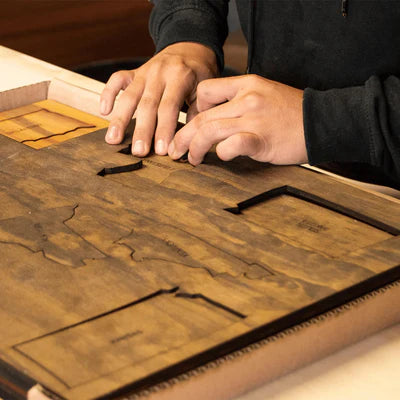
- Premium Quality: Crafted from durable 3mm (.14in) composite wood board for lasting enjoyment.
- Vibrant Imagery: High-resolution UV printing directly on the wood—no paper laminate—for stunning detail and vibrant colors.
- Eco-Conscious: Made with environmentally friendly materials.
- Heirloom Keepsake: Your puzzle arrives beautifully packaged in a handcrafted wooden box, perfect for gifting or storing your masterpiece.
Craftsmanship and Care:
Craftsmanship and Care:
Experience the satisfying click of perfectly interlocking pieces. Our state-of-the-art laser cutting ensures precise fit and a smooth, seamless puzzle-solving experience. The perfect upgrade from cardboard without breaking the bank.
- Natural Laser Residue: A small amount of harmless black residue from the laser cutting process may be present. Simply wipe it away with a damp cloth.
- Hand-Finished Details: Each puzzle board, each wooden box are all carefully hand-stained, painted, and glued.
Satisfaction Guaranteed:
Satisfaction Guaranteed:
We are confident in the quality of our puzzles. If you are not completely satisfied, we offer a full refund or exchange.
PLEASE NOTE:
Each puzzle is crafted to make the most of your chosen size. Artwork may be subtly adjusted to meet our material and production standards while honoring the original work. Planning to frame yours? Email info@whatawoodwork.com for final measurements.
Couldn't load pickup availability
In stock
 PRODUCT DESCRIPTION
Ivan Tsarevich rides to rescue a warrior queen from an immortal sorcerer. Bilibin drew it like it actually happened.
Ivan Bilibin made this illustration for Maria Morevna in 1913, at the height of his powers. The tale is one of the oldest and strangest in the Russian folk canon: Maria Morevna is not a princess waiting to be saved — she is a queen and a warrior who has already captured the deathless sorcerer Koschei and chained him in her cellar. When Ivan Tsarevich foolishly releases him, Koschei kidnaps Maria, and the rest of the tale is a series of desperate, near-fatal rescue attempts across the edge of the known world.
Bilibin shows the flight: two riders in full Rus' ceremonial dress, a bearded warrior-prince in embroidered red and gold kaftan and a woman in a tall kokoshnik headdress, her robes streaming behind them. The horses gallop across a dramatically foreshortened landscape — a river winding through a gorge below, a small vessel sailing beneath a sun-emblazoned sail, white doves rising into clouds rendered in Bilibin's signature decorative spirals. Every hem, every collar, every piece of horse tack carries its own ornamental program. Nothing in a Bilibin illustration is left unresolved.
He built this visual language deliberately. After years of ethnographic fieldwork in the Russian North, studying lubok woodcuts, medieval manuscript illumination, and Japanese printmaking, Bilibin developed a style so precise and so total that it redefined how Russians — and much of the world — picture the fairy tale. He drew his black outlines with a single kolinsky brush, one hair wide. The 1913 monogram in the lower right corner is his, and the date places this in the period when he was simultaneously producing fairy tale illustrations and designing stage sets for Rimsky-Korsakov operas at the Imperial theatres in St. Petersburg.
🎁 Who Gets One of These
✔️ The Russian folklore collector — You know the difference between Vasilisa and Maria Morevna. This is the illustration for the one who fights back.
✔️ The Art Nouveau and Mir Iskusstva enthusiast — Bilibin was a founding voice of the World of Art movement. A 1913 signed illustration is not a reproduction of a famous image — it is a work from the mature center of his career.
✔️ The puzzle buyer who wants maximum visual density — Every square centimeter of this illustration contains deliberate pattern. The tack on the horses, the clouds, the treeline, the river — assembly is essentially an exercise in learning Bilibin's ornamental grammar from the inside.
✔️ The Slavic art and folklore reader — Maria Morevna sits at the intersection of warrior-woman mythology, death-and-resurrection structure, and the Koschei the Deathless cycle. This image captures the pivotal moment of the tale without illustrating its ending.
✔️ The gift for someone who reads widely and decorates carefully — This is not a generic "Russian fairy tale" image. It is a specific scene from a specific tale, by the artist who defined the genre, in the year he was at his peak.
Strong occasion fits: birthdays for anyone serious about folklore, mythology, Eastern European art, or illustration history. A considered gift for the person who already owns everything obvious.
🧩 Puzzle Specifications
✔️ Precision laser-cut wooden pieces
✔️ 3mm MDF core — rigid, warp-resistant, built to last
✔️ UV printing directly on wood — no paper laminate, no peeling
✔️ Traditional grid-cut design
✔️ Sizes: 15"x23", 18"x24", 23"x31"
✔️ Piece counts: 300–1000
✔️ Handcrafted wooden keepsake box included
✔️ Made to order — ships in 3–4 weeks
💎 Why This Puzzle Lasts
Most wooden puzzle makers charge $300–$500. The craft justifies it. WAWW gets to the same materials through direct manufacturing and no wholesale chain. No retail markup, no distributor margin, no warehouse overhead. Made to order, which means no inventory sitting in a climate-controlled facility adding cost to the final price.
The 3mm MDF core is what keeps pieces clicking cleanly years from now. Cardboard compresses at the joints; MDF doesn't. Pieces cut from it hold their shape through humidity changes that would warp a standard cardboard puzzle in a single season. When you pick up a piece, it has weight. You feel the difference before you see it.
UV printing bonds ink directly to the wood surface rather than printing onto paper that's then laminated on top. For Bilibin's flat watercolor washes, that matters: there's no laminate layer to soften or yellow the pigment over time, and no edge to peel when the border pieces get handled repeatedly. The grid cut is traditional rather than novelty-shaped, which means the solving logic stays with the image rather than fighting it. When the puzzle is finished and framed or stored, the handcrafted wooden box holds up to use. People keep them on shelves. The box often outlasts the occasion it was bought for. Production is made to order, which means your puzzle doesn't exist until you order it. The 3–4 week wait is built into the process, not a delay.