
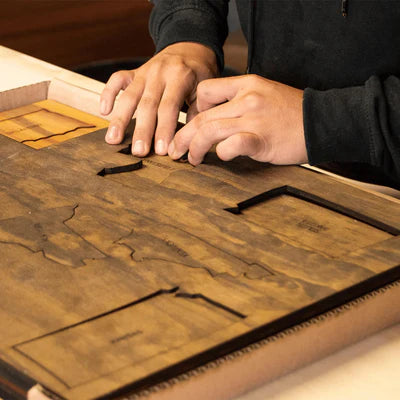


Here Be Monsters — Münster's 1570 Sea Chart Wooden Puzzle
Here Be Monsters — Münster's 1570 Sea Chart Wooden Puzzle
- Regular price
- Price: $115.00
- Regular price
- List Price: $0.00
- Sale price
- Price: $115.00
- Unit price
- per
Key Features:
Key Features:
- Premium Quality: Crafted from durable 3mm (.14in) composite wood board for lasting enjoyment.
- Vibrant Imagery: High-resolution UV printing directly on the wood—no paper laminate—for stunning detail and vibrant colors.
- Eco-Conscious: Made with environmentally friendly materials.
- Heirloom Keepsake: Your puzzle arrives beautifully packaged in a handcrafted wooden box, perfect for gifting or storing your masterpiece.
Craftsmanship and Care:
Craftsmanship and Care:
Experience the satisfying click of perfectly interlocking pieces. Our state-of-the-art laser cutting ensures precise fit and a smooth, seamless puzzle-solving experience. The perfect upgrade from cardboard without breaking the bank.
- Natural Laser Residue: A small amount of harmless black residue from the laser cutting process may be present. Simply wipe it away with a damp cloth.
- Hand-Finished Details: Each puzzle board, each wooden box are all carefully hand-stained, painted, and glued.
Satisfaction Guaranteed:
Satisfaction Guaranteed:
We are confident in the quality of our puzzles. If you are not completely satisfied, we offer a full refund or exchange.
PLEASE NOTE:
Each puzzle is crafted to make the most of your chosen size. Artwork may be subtly adjusted to meet our material and production standards while honoring the original work. Planning to frame yours? Email info@whatawoodwork.com for final measurements.
Couldn't load pickup availability
In stock
 PRODUCT DESCRIPTION
This is Sebastian Münster's Sea Monsters map, c.1570 — one of the most iconic cartographic illustrations in history. The German title roughly translates to "Sea Wonders and Strange Creatures found in the Northern Lands, in the Sea and on Land." — Now made into a wooden jigsaw puzzle
Münster didn't invent the sea monsters. He copied them, carefully, from Olaus Magnus's 1539 Carta Marina — a map so alarming that sailors reportedly used it to justify avoiding the North Atlantic altogether. The giant lobsters and aggressive whales weren't decoration. They were the argument.
📖 The Story Behind This Piece
Münster's map of Scandinavia first appeared in the 1544 edition of his Cosmographia, the most widely read geographic encyclopedia of the Renaissance. It covers Norway, Sweden, Finland, Iceland, and the Baltic Sea — and at least a dozen creatures that no sailor had actually seen. The sea serpents coiling around merchant vessels, the vast whales overturning ships, the crustaceans large enough to swallow men whole: each one placed with deliberate geographic specificity, labeled, given a name. Münster wasn't being credulous. He was recording what counted as knowledge in 1544, which included everything sailors swore they'd encountered in northern waters.
Münster was a professor of Hebrew at the University of Basel who taught himself cartography because he believed geography and scripture were the same project — understanding the shape of God's world. He sourced material from correspondents across Europe, correcting and updating across dozens of editions of the Cosmographia. His maps held authority partly because he admitted what he didn't know, then illustrated the uncertainty with woodcut monsters rather than leaving the ocean blank.
The dark, dense woodcut linework is where assembly gets interesting. The open ocean sections aren't empty — they're crosshatched with shadow, and the creatures interrupt the pattern unexpectedly as you work outward from the coastline. On wood, UV-printed without laminate, the ink sits in the grain rather than on top of it, which pulls the aged quality of the original woodcut forward. A detail that reads as texture on a screen turns out to be a ship's rigging or a monster's tail. You find out when you get there.
🎁 Who Gets One of These
A few specific kinds of people end up with this one.
✔️ The antique map collector who's run out of wall space — You already own the framed reproductions. A puzzle of Münster's Cosmographia map sits differently: something to do with it, then keep.
✔️ The medieval and Renaissance history reader — Someone who knows Olaus Magnus's name, or will look it up the moment they see it in the box copy. The sourcing alone is worth the conversation.
✔️ The Scandinavian studies professor or Nordic heritage enthusiast — Norway, Sweden, Finland, Iceland — all present, all distorted in Münster's characteristically fascinating ways. The errors are as interesting as the accuracy.
✔️ The fantasy reader who takes worldbuilding seriously — Sea serpents with geographic coordinates. Labeled monsters. A cartographer treating mythology as data. That's a different kind of fantasy map.
✔️ The person who buys gifts that require explanation — Not in a difficult way. In the way where the recipient asks a question and an hour disappears.
Works well as a birthday present for anyone with a love for monsters, mythical creatures, or with a Scandinavian connection.
🧩 Puzzle Specifications
✔️ Precision laser-cut wooden pieces
✔️ 3mm MDF core — rigid, warp-resistant, built to last
✔️ UV printing directly on wood — no paper laminate, no peeling
✔️ Traditional grid-cut design
✔️ Handcrafted wooden keepsake box included
✔️ Made to order — ships in 3–4 weeks
💎 Why This Puzzle Lasts
Comparable wooden puzzles from established brands run $300 to $500. The craft genuinely justifies that range. We reach the same materials through direct manufacturing and no wholesale chain, which takes a significant amount out of the price without taking anything out of the object.
The 3mm MDF core is what makes the pieces feel solid in your hand. Cardboard compresses, warps with humidity, and eventually stops fitting cleanly. MDF doesn't. The pieces click the same way on the first assembly as they will on the tenth. UV printing goes directly onto the wood surface, no paper layer between the ink and the material. Nothing to peel, nothing to crack along a fold, no color shift as the years go by. Münster's woodcut linework stays as sharp as the day it arrived.
The traditional grid cut means every piece has a clear, satisfying lock — no novelty shapes to second-guess, just the clean logic of a well-made puzzle. When you're done, the wooden keepsake box doesn't go in recycling. It's a built object, the same quality as the puzzle itself, and it ends up somewhere permanent. Made to order means no warehouse inventory, no overproduction. Your puzzle gets made when you buy it. The three-to-four-week lead time is the manufacturing time, not shipping delay.
🖼️ After You Finish It
Most people frame it. The wooden box holds the reference image and ends up on a bookshelf, usually near the frame. Visitors notice the monsters first, then ask about the map, and the conversation almost always lands on Olaus Magnus and why a Basel professor spent years illustrating creatures no one had verified. Münster's Cosmographia went through 46 editions between 1544 and 1628. People kept buying it partly for the monsters.