


Shoki the Demon Queller — Kawanabe Kyosai Wooden Puzzle
Shoki the Demon Queller — Kawanabe Kyosai Wooden Puzzle
- Regular price
- Price: $115.00
- Regular price
- List Price:
- Sale price
- Price: $115.00
- Unit price
- per
Key Features:
Key Features:
- Premium Quality: Crafted from durable 3mm (.14in) composite wood board for lasting enjoyment.
- Vibrant Imagery: High-resolution UV printing directly on the wood—no paper laminate—for stunning detail and vibrant colors.
- Eco-Conscious: Made with environmentally friendly materials.
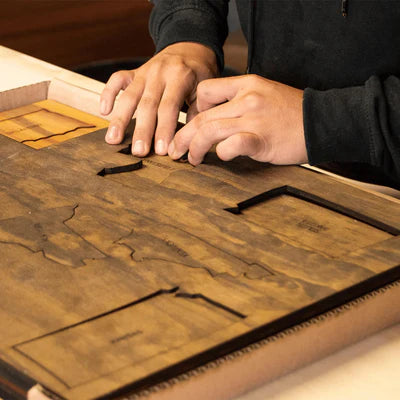
- Heirloom Keepsake: Your puzzle arrives beautifully packaged in a handcrafted wooden box, perfect for gifting or storing your masterpiece.
Craftsmanship and Care:
Craftsmanship and Care:
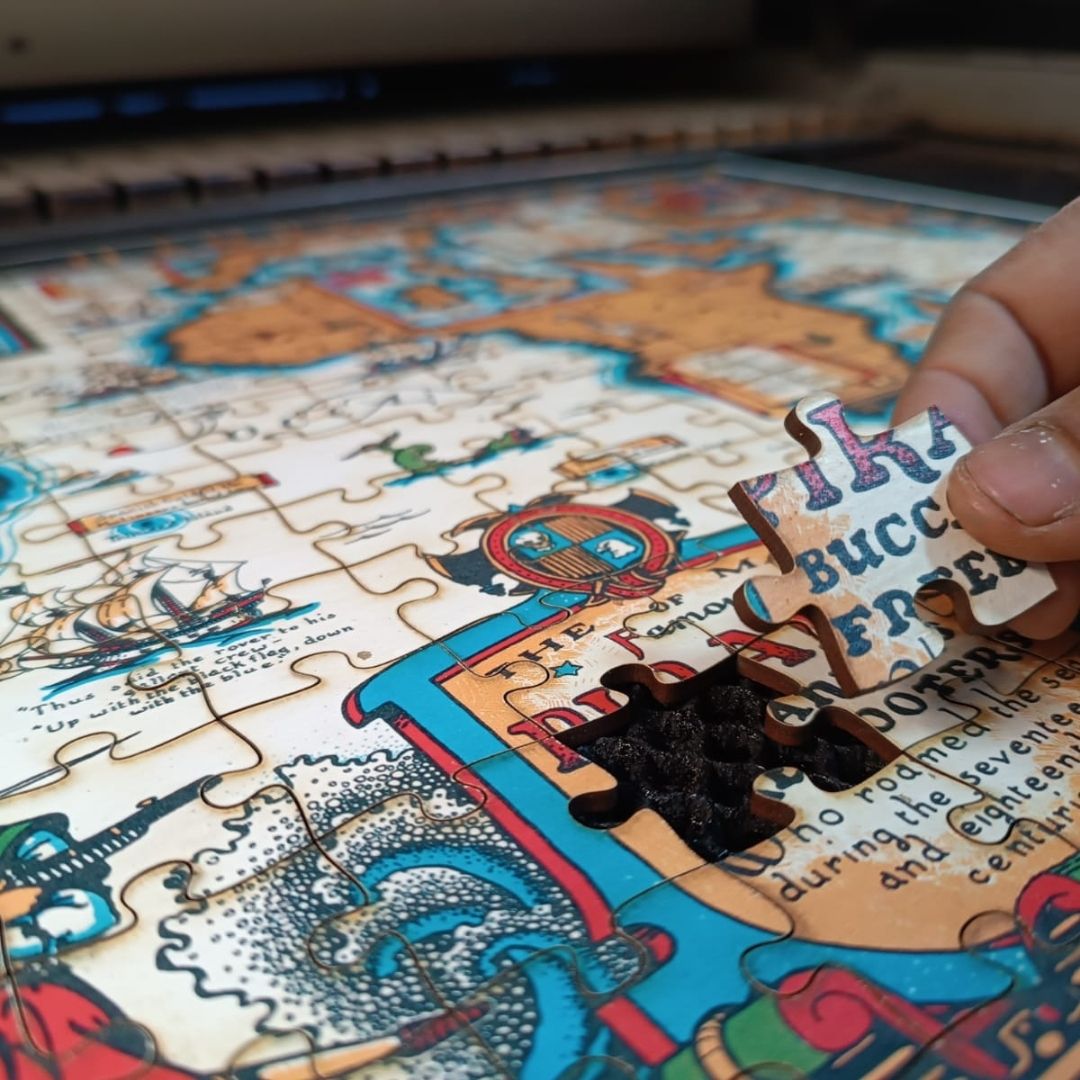
Experience the satisfying click of perfectly interlocking pieces. Our state-of-the-art laser cutting ensures precise fit and a smooth, seamless puzzle-solving experience. The perfect upgrade from cardboard without breaking the bank.
- Natural Laser Residue: A small amount of harmless black residue from the laser cutting process may be present. Simply wipe it away with a damp cloth.
- Hand-Finished Details: Each puzzle board, each wooden box are all carefully hand-stained, painted, and glued.
Satisfaction Guaranteed:
Satisfaction Guaranteed:
We are confident in the quality of our puzzles. If you are not completely satisfied, we offer a full refund or exchange.
PLEASE NOTE:
Each puzzle is crafted to make the most of your chosen size. Artwork may be subtly adjusted to meet our material and production standards while honoring the original work. Planning to frame yours? Email info@whatawoodwork.com for final measurements.
Couldn't load pickup availability
In stock
 PRODUCT DESCRIPTION
Shoki Riding a Tiger and Attacking a Group of Demons, May from Twelve Months — Wooden Jigsaw Puzzle
Kawanabe Kyōsai printed the English word "MAY" directly onto this 1887 woodblock triptych. Not as decoration. As a statement. Japan was 19 years into the Meiji era, Western calendars were displacing the old lunar system, and Kyōsai folded that collision into a print of a Chinese demon-queller riding a tiger through a mob of goblins. The folklore is ancient. The typography is pointed.
📖 The Story Behind This Piece
Made in 1887 as part of the series Junikagetsu no uchi (Of the Twelve Months), this triptych represents May, the month of the Boys' Day festival, Tango no Sekku, when Shōki imagery appeared on banners and in homes across Japan as a ward against evil. Kyōsai spreads the scene across three vertical panels: Shōki atop a lunging tiger, sword drawn, scattering a crowd of small demons who scatter in every direction at once. The energy is almost comedic. The violence is not.
Kyōsai earned the nickname "Painting Demon" not as flattery but as a description of how he worked. He trained in the Kanō school, absorbed ukiyo-e technique, studied Western anatomy, and then spent the rest of his career refusing to settle into any single style. His decision to inscribe "MAY" in Roman lettering on a print rooted in centuries-old Chinese and Japanese folklore was not an accident of modernization. It was a wry acknowledgment that two calendars now coexisted in Japan, and that Shōki, protector against disease and malevolent spirits, was apparently useful in both systems.
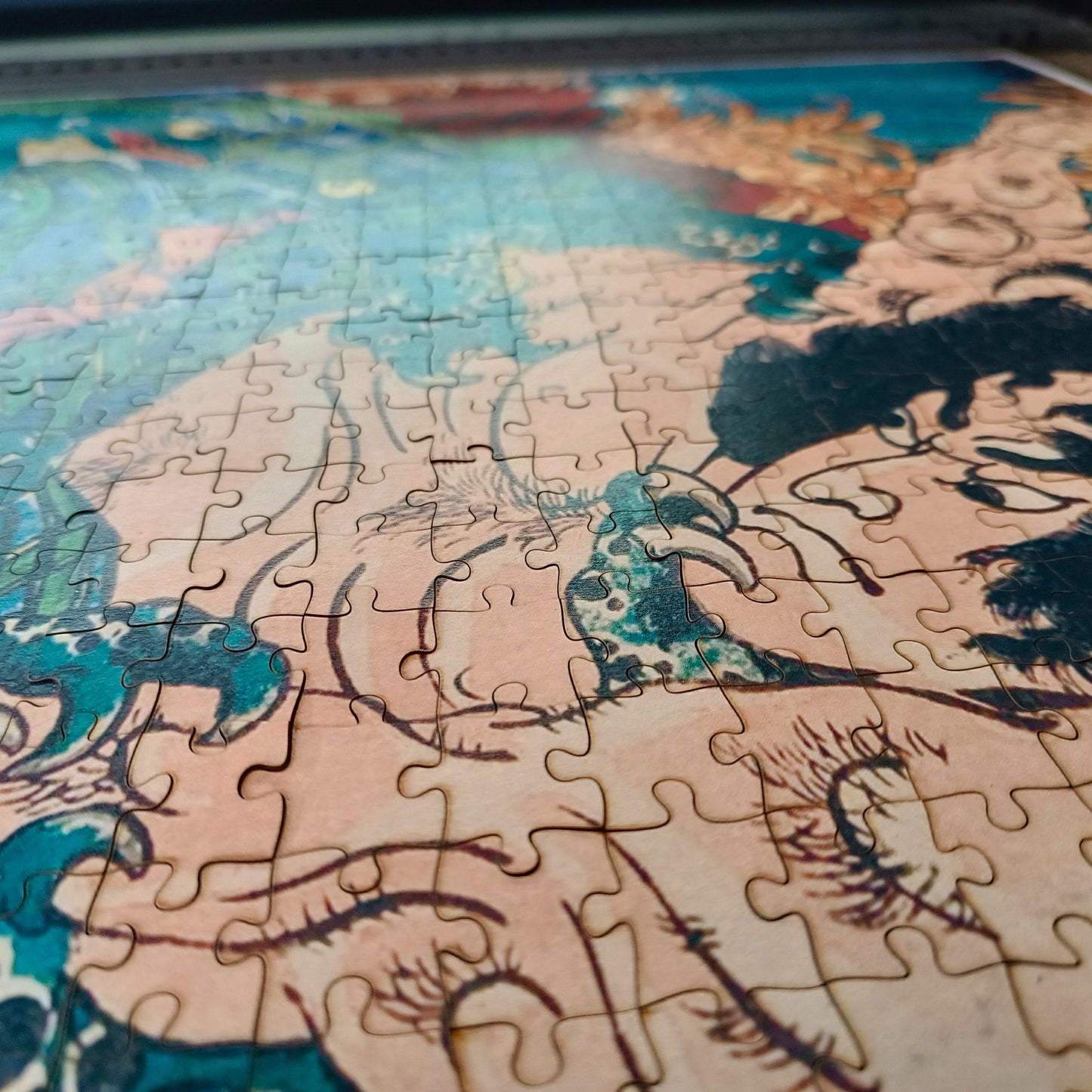
The triptych format creates a specific puzzle problem: the seams between the three original panels become zones of dense, close-toned ink. The demon figures in the lower third are rendered in dark blues and greys against a deep ground, and once you start sorting that section, you'll notice that Kyōsai gave each demon a distinct expression. Panic, defiance, a flash of something almost like recognition. UV printing directly onto the wood surface means those tonal differences survive. On paper laminate, that section would go flat. Here the ink depth holds, and sorting by demon face becomes a workable strategy.
🎁 Who Gets One of These
A few specific people come to mind without much effort.
✔️ The ukiyo-e collector who already owns prints — You know Kyōsai's reputation and probably have an opinion about where he sits relative to Hokusai. Rebuilding this triptych piece by piece is a different kind of looking than hanging it on a wall.
✔️ The Japan traveler who visited during Golden Week — You saw the carp kites and knew what Boys' Day meant. Shōki is the other half of that festival, and most tourists never see him.
✔️ The art history reader who's gotten deep into the Meiji period — The "MAY" inscription alone makes this a document, not just a print. The puzzle gives you three weeks to think about what Kyōsai was doing with it.
✔️ The person who decorates with intention and hates mass-produced art — Dark palette, mythological subject, triptych scale. Framed, it fills a wall without competing with the room.
✔️ The father who's hard to shop for and has everything — Shōki is specifically a Boys' Day image, a figure associated with protection and strength. The subject matter does the work that a card usually fails to do.
Father's Day is the clearest occasion match here. The Boys' Day association is direct, not a stretch. Works equally well for a birthday gift to anyone who collects Japanese art or has a serious interest in Meiji-era cultural history.
💎 Why This Puzzle Lasts
Most wooden puzzle makers charge $300–$500. The craft justifies that price. WAWW gets to the same materials through direct manufacturing and no wholesale chain. Made to order, no warehouse inventory, no markup passed down from three intermediaries. The savings are structural, not a signal of corner-cutting.
The base is 3mm MDF, rigid enough that pieces click together cleanly after twenty years on a shelf. Cardboard puzzles flex and warp with humidity; the cuts loosen and pieces stop fitting the way they should. MDF doesn't move. The first time you pick up a piece, you feel the difference in weight before you fit it anywhere.
The image is UV-printed directly onto the wood surface. No paper laminate means no layer to bubble, crack, or peel at the edges over time. For a print like this one, where tonal gradations in the dark passages carry real information, that matters. The ink sits in the wood. The demon faces in the lower third stay legible.
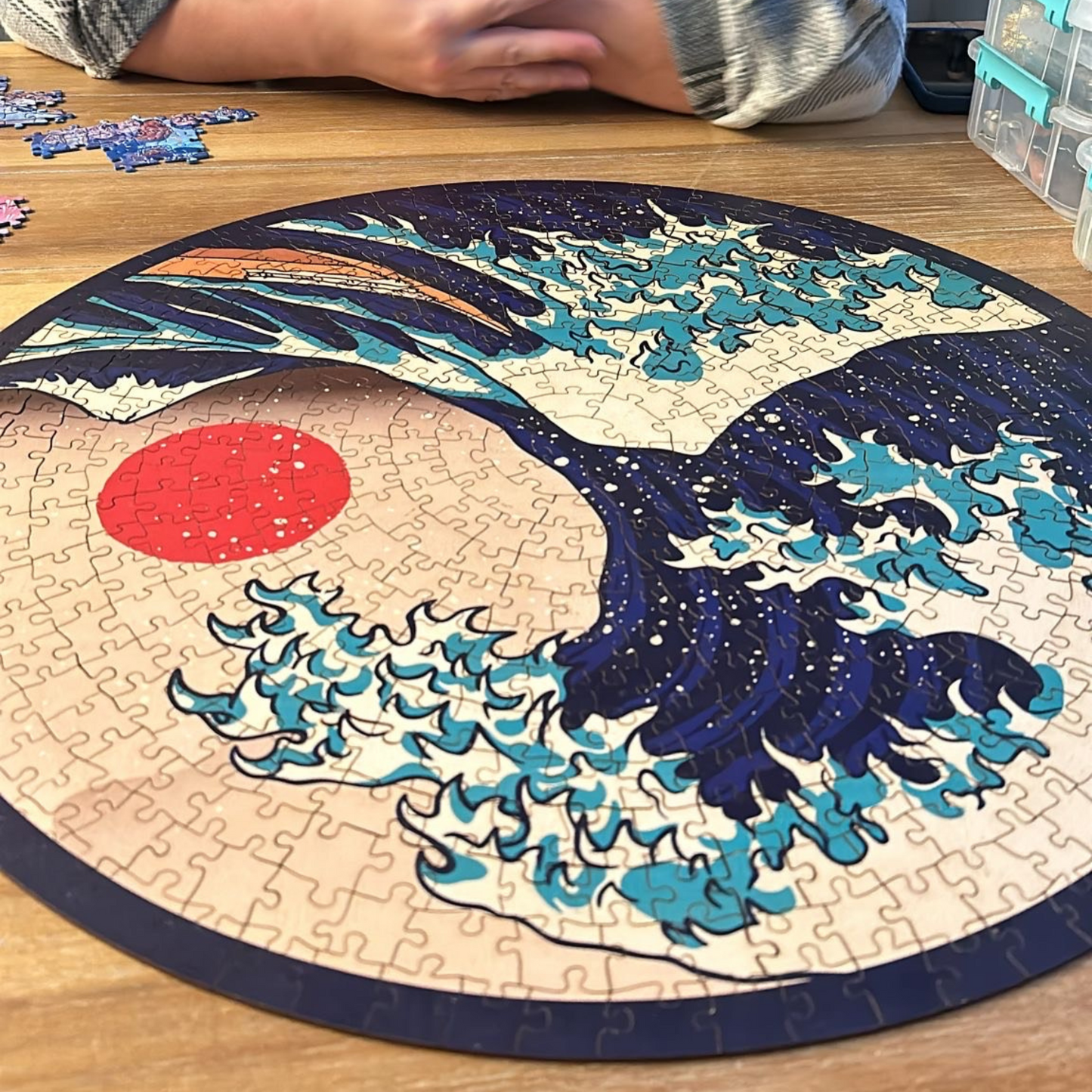
The grid cut is traditional, no novelty shapes, no irregular silhouettes designed to frustrate. Pieces fit with a definite click. You know when you're right. Sorting by color and pattern works the way it's supposed to, and the three-panel structure of the original triptych gives you a natural way to section the work.
The wooden keepsake box ships as part of the object, not as packaging to be recycled. After the puzzle is framed or stored, the box stays. It's well-made enough that people keep it on a shelf and put things in it. Production is made to order, which means your puzzle doesn't exist until you order it. The 3–4 week wait is the direct result of making nothing speculatively, a constraint that also means zero warehouse waste and a puzzle cut specifically for your order.
The 300-piece, 15"x23" starts at $115. The 1000-piece, 23"x31" runs $170.
🖼️ After You Finish It
Most people frame a triptych this size. The wooden box ends up nearby, on a shelf or a side table, usually still holding a few stray pieces people kept aside. Visitors ask about the image first, specifically about the figure on the tiger. Then they ask about the word "MAY" in the corner, and that question takes a while to answer well. Kyōsai made over a thousand works across a fifty-year career, and Shoki Riding a Tiger is one of the few where the politics and the folklore land in the same panel.
⚠️ Important Notes
Puzzles may have light laser residue on the surface — a damp cloth handles it. There's a natural wood scent when the box first opens; it fades within a few days. Made-to-order production means your puzzle ships in 3–4 weeks. If anything arrives damaged, we replace or refund. No questions.