


Laughing Oni — Hokusai's Demon Woodblock Wooden Puzzle
Laughing Oni — Hokusai's Demon Woodblock Wooden Puzzle
- Regular price
- Price: $115.00
- Regular price
- List Price: $0.00
- Sale price
- Price: $115.00
- Unit price
- per
Key Features:
Key Features:
- Premium Quality: Crafted from durable 3mm (.14in) composite wood board for lasting enjoyment.
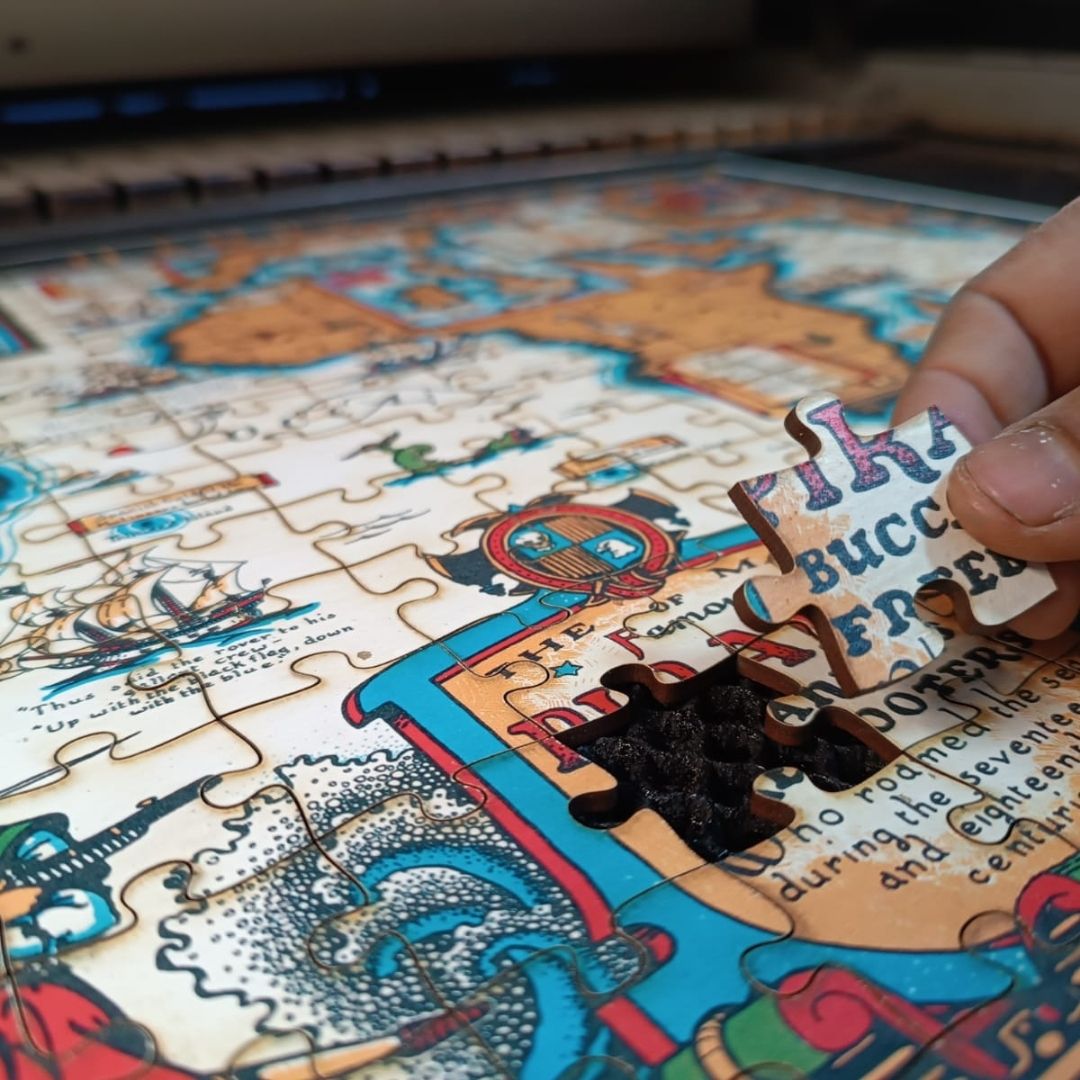
- Vibrant Imagery: High-resolution UV printing directly on the wood—no paper laminate—for stunning detail and vibrant colors.
- Eco-Conscious: Made with environmentally friendly materials.
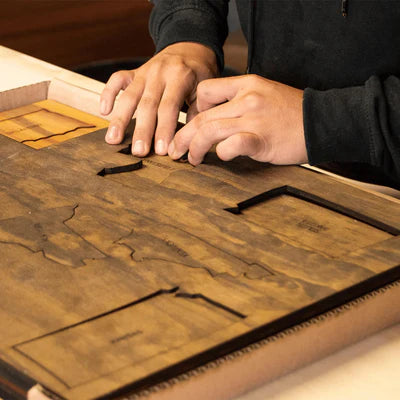
- Heirloom Keepsake: Your puzzle arrives beautifully packaged in a handcrafted wooden box, perfect for gifting or storing your masterpiece.
Craftsmanship and Care:
Craftsmanship and Care:
Experience the satisfying click of perfectly interlocking pieces. Our state-of-the-art laser cutting ensures precise fit and a smooth, seamless puzzle-solving experience. The perfect upgrade from cardboard without breaking the bank.
- Natural Laser Residue: A small amount of harmless black residue from the laser cutting process may be present. Simply wipe it away with a damp cloth.
- Hand-Finished Details: Each puzzle board, each wooden box are all carefully hand-stained, painted, and glued.
Satisfaction Guaranteed:
Satisfaction Guaranteed:
We are confident in the quality of our puzzles. If you are not completely satisfied, we offer a full refund or exchange.
PLEASE NOTE:
Each puzzle is crafted to make the most of your chosen size. Artwork may be subtly adjusted to meet our material and production standards while honoring the original work. Planning to frame yours? Email info@whatawoodwork.com for final measurements.
Couldn't load pickup availability
In stock
 PRODUCT DESCRIPTION
The Laughing Demon (Katsushika Hokusai, c. 1831–1832) — Wooden Jigsaw Puzzle
Hokusai made only five prints in the One Hundred Ghost Stories series before abandoning it. Nobody knows why he stopped. What survives is a demon with a maniacal grin clutching a severed infant's head, rendered in Prussian blue — a pigment so new to Japan at the time that its chemical formula had only recently arrived from Europe. The series was meant to go to a hundred. It went to five. The Laughing Demon is one of them.
📖 The Story Behind This Piece
"This gleeful cannibal is an unholy union of two other monsters: a “hannya”, whose jealousy has turned her into a horned demon; and a “yamanba”, who dwells in the mountains living off the meat of kidnapped children."
Around 1831, a popular Edo-period parlor game involved gathering to tell ghost stories, extinguishing one candle after each tale. The room grew darker as the stories multiplied. Hokusai built this series around that ritual. The demon in this print fuses two figures from Japanese folklore: the Hannya, a woman consumed and disfigured by jealous obsession, and the Yamauba, a mountain witch associated with devouring children. Hokusai didn't choose between them. He collapsed both into one figure, grinning.
Hokusai was in his early seventies when he made this print. By then he had moved house more than ninety times and changed his name at least thirty times — each name marking what he considered a new artistic self. The use of Prussian blue here was deliberate and technically sophisticated. He had used it earlier in The Great Wave. For a ghost series, its cold, chemical quality was exactly right — nothing in traditional Japanese pigments produced that particular shade of dread.
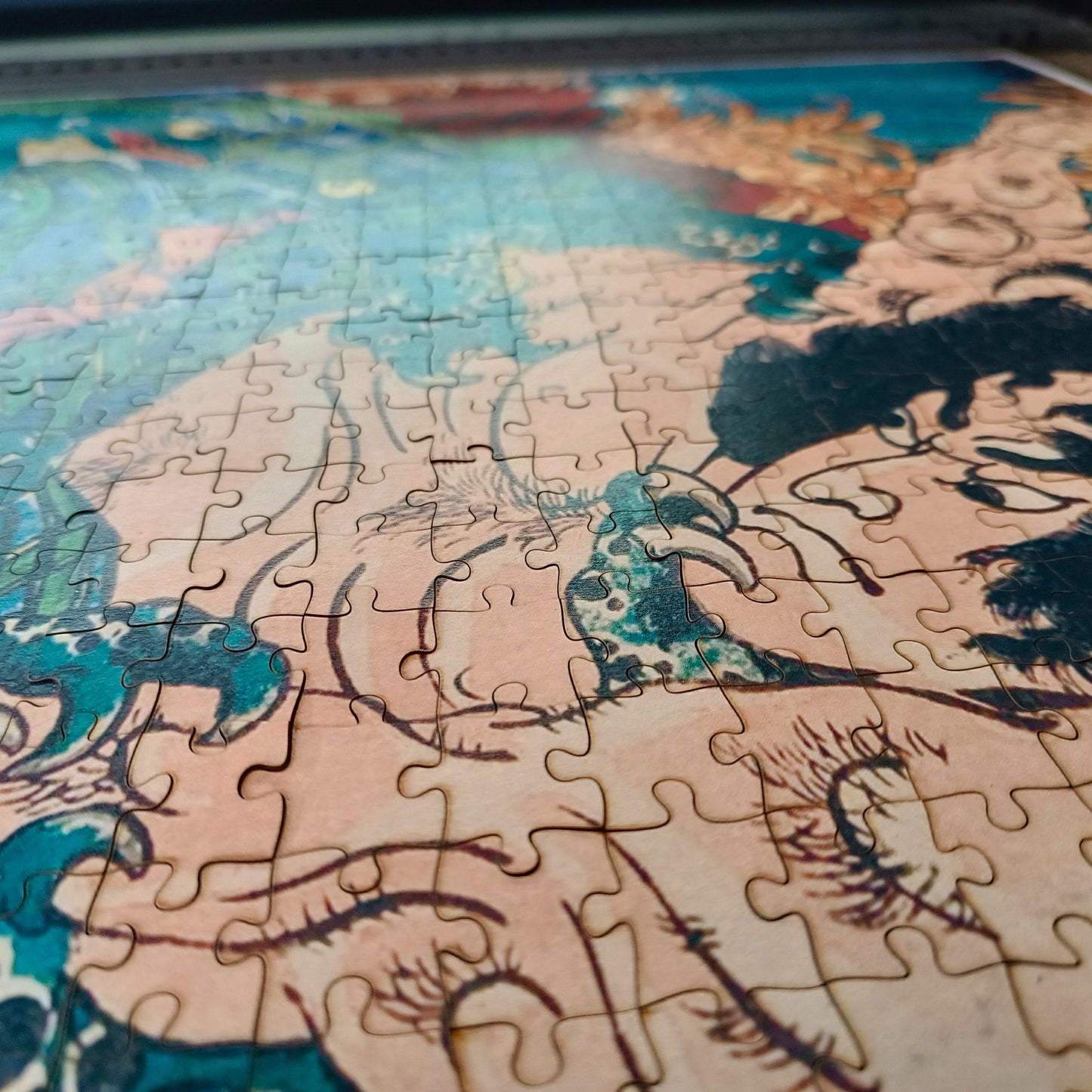
The demon's face is where assembly gets complicated. The grin spans nearly the full width of the figure's head, and the teeth are rendered in fine, close detail against the blue. In a digital thumbnail, those teeth blur together. On the laser-cut wooden pieces, UV printing on bare wood pulls the contrast out fully — you'll be holding individual pieces with visible brushstroke-like gradations in the blue ground, sorting them by tone before you even know where they go. The infant's hand, partially obscured by the demon's grip, only becomes legible at the end.
🎁 Who Gets One of These
A few types of people buy this one specifically.
✔️ The Japanese art collector with a print or two already on the wall — You know the Hyaku monogatari series. You probably didn't expect to find one of its five surviving prints as a wooden puzzle, built to stay.
✔️ The folklore scholar or enthusiast who tracks the Hannya through Noh theater, lacquerware, and tattoo culture — Hokusai's conflation of Hannya and Yamauba into one figure is an editorial choice worth spending time with, piece by piece.
✔️ The person who collects dark or macabre art without apology — A severed infant's head held by a grinning demon, made by one of history's great artists in 1831. It belongs framed, not hidden.
✔️ The museum member who shops the gift shop after every exhibition — Official impressions of this print are held at the British Museum and the Museum of Fine Arts, Boston. The puzzle costs less than a flight to see either one.
✔️ The gift-giver who knows someone obsessed with Edo-period Japan — Specific enough to land, substantial enough to keep.
Halloween is the obvious occasion, and it's the right one — the subject matter fits without forcing it. Strong housewarming gift for someone who decorates with intent rather than convention.
🧩 Puzzle Specifications
✔️ Precision laser-cut wooden pieces
✔️ 3mm MDF core — rigid, warp-resistant, built to last
✔️ UV printing directly on wood — no paper laminate, no peeling
✔️ Traditional grid-cut design
✔️ Handcrafted wooden keepsake box included
✔️ Made to order — ships in 3–4 weeks
💎 Why This Puzzle Lasts
Most wooden puzzle makers charge $300–$500. The craft justifies it. WAWW gets to the same place differently: direct manufacturing, no wholesale chain, made strictly to order. The materials are the same. The markup isn't there.
The 3mm MDF core is why older cardboard puzzles warp and these don't. Rigid under humidity, rigid under pressure, pieces click together with the same resistance in year one as in year fifteen. UV printing bonds ink directly to the wood surface with no paper layer between them. No laminate means no peeling at the edges, no fading from light exposure, and nothing softening the contrast between that Prussian blue ground and the pale, terrible grin above it.
The grid cut is traditional by design — no novelty shapes, no gimmick pieces. What you get is a clean solve where the image, not the cut, is the puzzle. When the pieces are done, they go back into the handcrafted wooden box that shipped them. The box isn't packaging. It's what you keep on the shelf afterward. Every puzzle is made after you order it. No warehouse, no overstock. The 3–4 week lead time is what made-to-order actually means.