




Funny Spirits of Old Japan — Vintage Yokai Woodblock Puzzle
Funny Spirits of Old Japan — Vintage Yokai Woodblock Puzzle
- Regular price
- Price: $115.00
- Regular price
- List Price: $0.00
- Sale price
- Price: $115.00
- Unit price
- per
Key Features:
Key Features:
- Premium Quality: Crafted from durable 3mm (.14in) composite wood board for lasting enjoyment.
- Vibrant Imagery: High-resolution UV printing directly on the wood—no paper laminate—for stunning detail and vibrant colors.
- Eco-Conscious: Made with environmentally friendly materials.
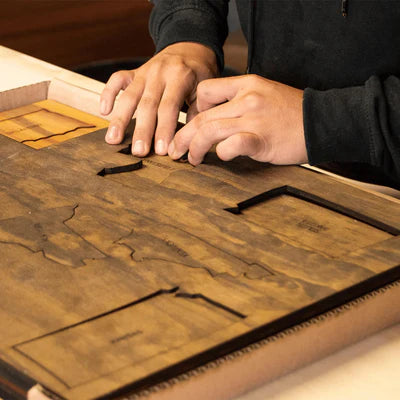
- Heirloom Keepsake: Your puzzle arrives beautifully packaged in a handcrafted wooden box, perfect for gifting or storing your masterpiece.
Craftsmanship and Care:
Craftsmanship and Care:
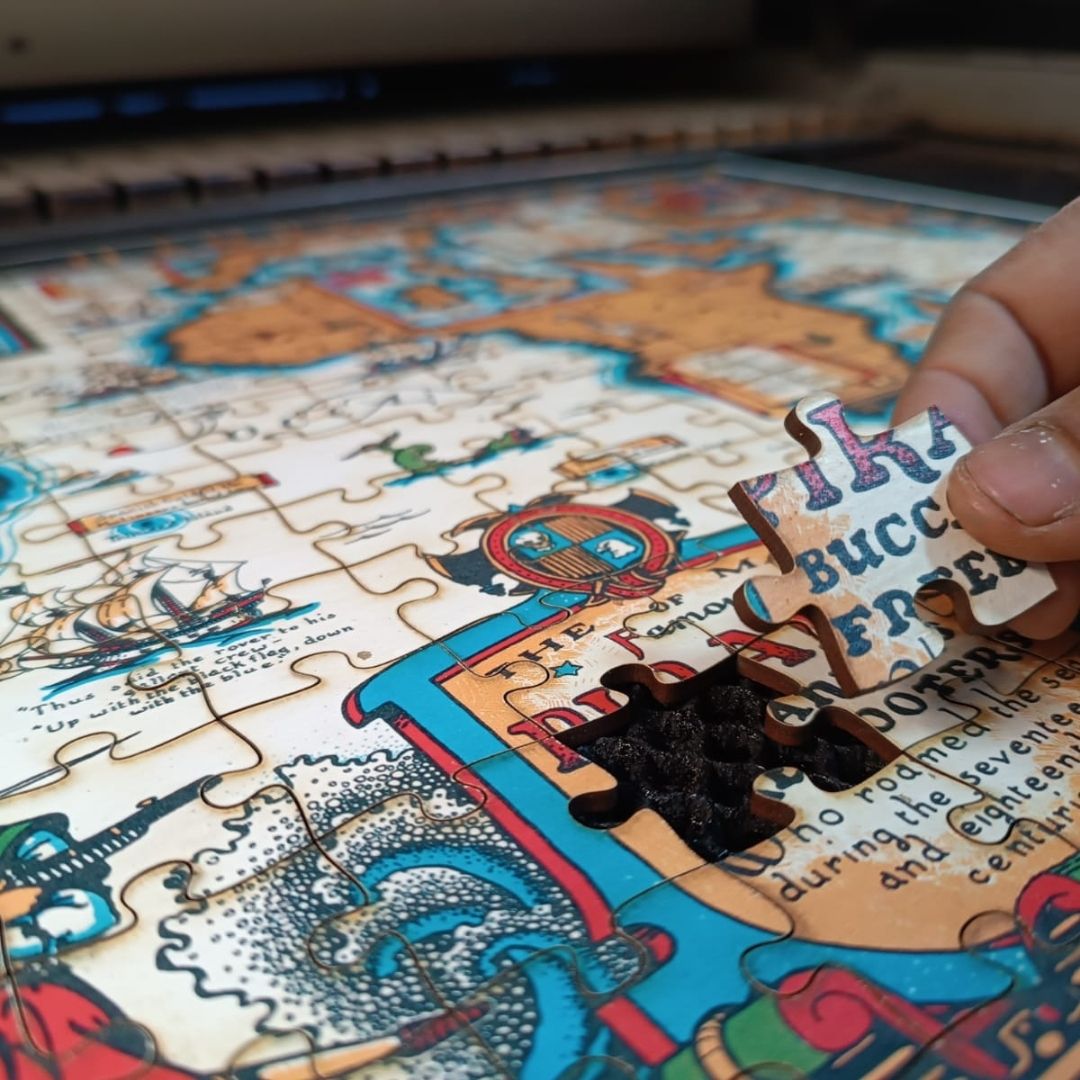
Experience the satisfying click of perfectly interlocking pieces. Our state-of-the-art laser cutting ensures precise fit and a smooth, seamless puzzle-solving experience. The perfect upgrade from cardboard without breaking the bank.
- Natural Laser Residue: A small amount of harmless black residue from the laser cutting process may be present. Simply wipe it away with a damp cloth.
- Hand-Finished Details: Each puzzle board, each wooden box are all carefully hand-stained, painted, and glued.
Satisfaction Guaranteed:
Satisfaction Guaranteed:
We are confident in the quality of our puzzles. If you are not completely satisfied, we offer a full refund or exchange.
PLEASE NOTE:
Each puzzle is crafted to make the most of your chosen size. Artwork may be subtly adjusted to meet our material and production standards while honoring the original work. Planning to frame yours? Email info@whatawoodwork.com for final measurements.
Couldn't load pickup availability
In stock
 PRODUCT DESCRIPTION
Shinpan Bakemono Zukushi — Wooden Jigsaw Puzzle
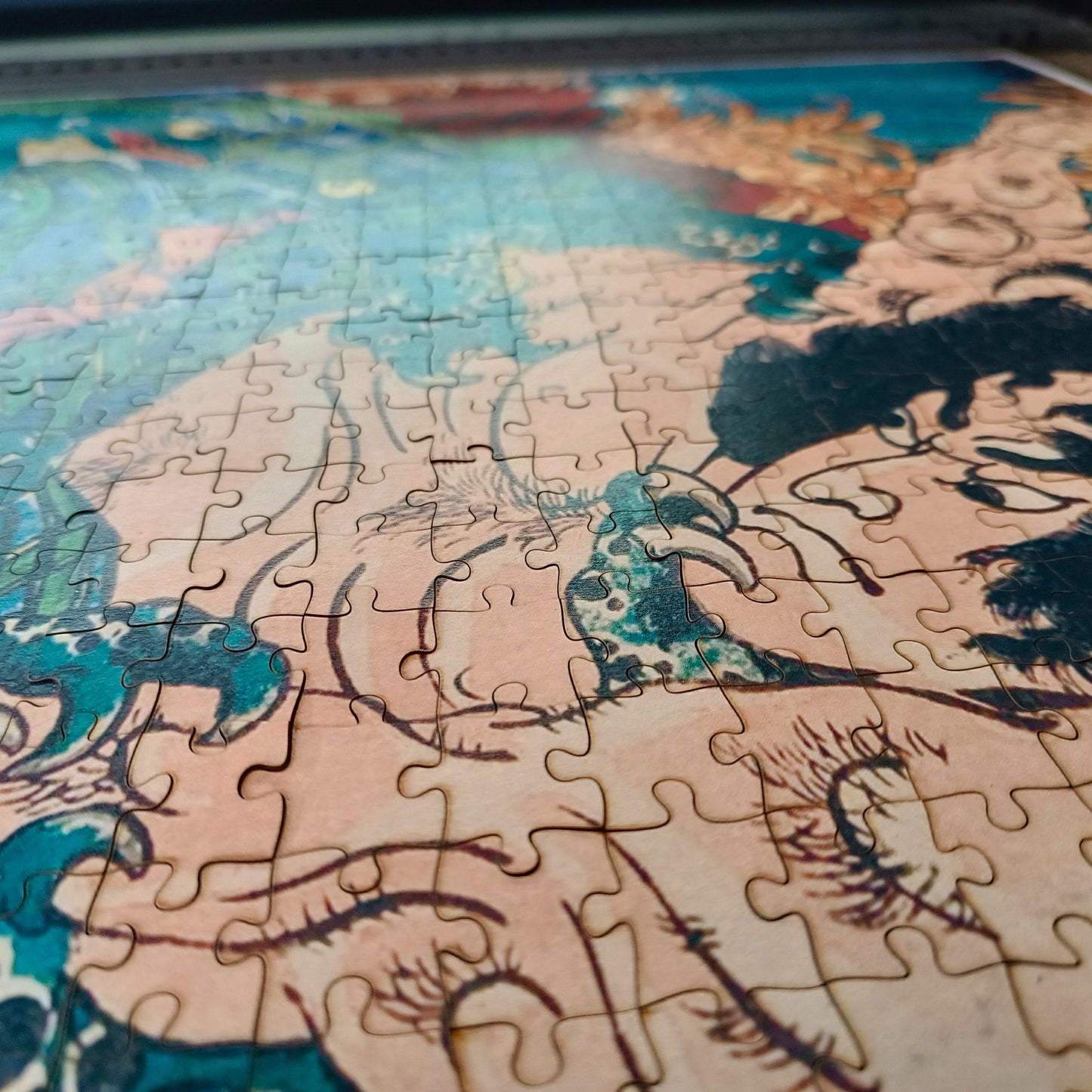
In 1860, a Japanese artist published a print of household objects having a very bad time. Sandals are walking without feet. Lanterns are grimacing. Umbrellas are furious about something. The genre was called omocha-e, toy prints, and children were supposed to play with them. Adults bought them too. Nobody was entirely sure where the joke ended.
📖 The Story Behind This Piece
Utagawa Shigekiyo published Shinpan bakemono zukushi in the tenth month of 1860, during a period when Edo's printing culture was producing work at a pace that would look familiar today: fast, popular, and funnier than posterity usually gives it credit for. The subject is tsukumogami, a category of yokai defined by a specific rule: any object that reaches 100 years old acquires a spirit. The lanterns and sandals and umbrellas crowding Shigekiyo's composition are not random. Each one earned its sentience through sheer longevity. The print sits now in the William Sturgis Bigelow Collection at the Museum of Fine Arts, Boston.
Shigekiyo trained under Utagawa Kuniyoshi, the ukiyo-e master who made demon prints visceral and warrior prints operatic. What Shigekiyo took from that education was the compositional instinct for controlled chaos, figures overlapping, expressions pushed to the edge of legibility, negative space used sparingly. He applied it not to warriors but to kitchen objects throwing a fit. That choice, deploying a dramatic visual vocabulary on completely undignified subject matter, is what makes the print funny and strange in equal measure.
The image is dense. When you're working through the lower register of the composition, you'll hit a section where three or four objects are tangled together, their outlines bleeding into each other, and you'll need to sort them by color temperature rather than shape. UV printing directly on the 3mm MDF holds the ochres and muted reds Shigekiyo used with a flatness that matches the original woodblock aesthetic. No paper laminate means no brightening, no gloss shift. The colors read the way they were meant to read, slightly dry, slightly aged, completely intentional.
🎁 Who Gets One of These
A few specific kinds of people have been looking for exactly this without knowing it existed.
✔️ The Japan scholar who has read at least one academic paper on yokai taxonomy — You know the difference between a kappa and a tanuki. Tsukumogami are their own category, and Shigekiyo's 1860 print is one of the cleaner examples of the genre in any Western museum collection.
✔️ The ukiyo-e collector whose walls are running out of room — A wooden puzzle of a Bigelow Collection print is a different kind of owning. The finished piece frames well, and the original stays in Boston where it belongs.
✔️ The person who bought a cardboard puzzle during the pandemic and is still thinking about it — You know what you want now. Wood pieces with actual weight, a box worth keeping, an image that doesn't embarrass anyone.
✔️ The folklore reader who annotates their books — If Lafcadio Hearn is on your shelf, or Noriko Reider's work on tsukumogami, you'll spend half the assembly identifying which household object is which and why it's angry.
✔️ The gift-giver who refuses to give something forgettable — Shigekiyo is not a household name in the West. Finding this print, having it made, giving it in a handcrafted wooden box: that's research that shows.
Works as a gift for birthdays where the recipient is serious about Japanese art or folklore, for milestones where something handmade and lasting is the right register, and for anyone who has recently visited a Japanese art collection and left wanting more than a catalog.
🧩 Puzzle Specifications
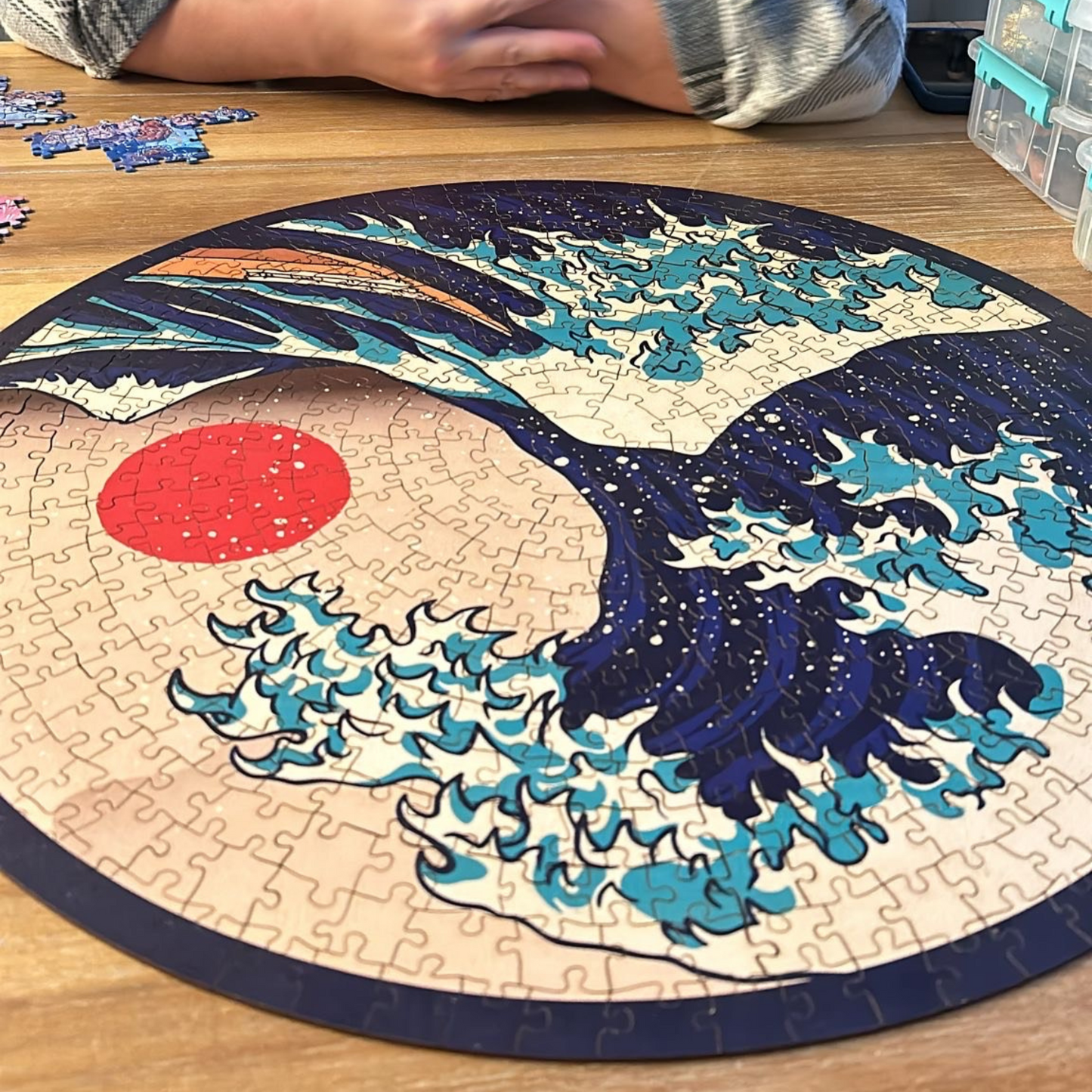
✔️ Precision laser-cut wooden pieces
✔️ 3mm MDF core — rigid, warp-resistant, built to last
✔️ UV printing directly on wood — no paper laminate, no peeling
✔️ Traditional grid-cut design
✔️ Sizes: 15"x23", 18"x24", 23"x31"
✔️ Piece counts: 300–1000
✔️ Handcrafted wooden keepsake box included
✔️ Made to order — ships in 3–4 weeks
💎 Why This Puzzle Lasts
Most wooden puzzle makers charge $300 to $500. The craft justifies it. WAWW gets there differently: direct manufacturing, no wholesale chain, made to order in small batches. Same materials, same laser precision, no markup from four middlemen. The price reflects the actual cost of the thing, not the cost of the supply chain around it.
The 3mm MDF core is rigid in a way cardboard stops being after two or three assemblies. Pieces don't soften at the edges, don't absorb humidity, don't lose their click. Fit a piece correctly in year one and it fits the same way in year fifteen. UV printing bonds color directly to the wood surface rather than laying a paper skin over it. No laminate means no peeling corner, no bubbling, no color shift when the light hits it at an angle. What Shigekiyo's printer achieved with woodblock ink in 1860 is reproduced here without the modern habit of making old things look newer than they are.
The laser cut follows a traditional grid pattern because gimmick-shaped pieces solve differently, and not better. Interlocking tabs and blanks feed a clean, satisfying connection on every join. When the puzzle is done, the wooden keepsake box doesn't go in recycling. People put them on shelves, use them as small storage, keep them because they're worth keeping. Made to order means your puzzle doesn't exist until you order it. No warehouse, no unsold stock sitting under fluorescent lights. Production takes three to four weeks, and that wait is the reason the materials are what they are.
The 300-piece, 15"x23" starts at $115. The 1000-piece, 23"x31" runs $170.
🖼️ After You Finish It
Most people frame it. The wooden box ends up on the shelf underneath, or nearby on a desk. Visitors notice the image first, the grimacing lanterns and the indignant sandals, and they ask what it is, because nothing about it looks like what they expected a puzzle to look like. Shinpan bakemono zukushi has been in the Bigelow Collection for over a century. Rebuilding it piece by piece is a different kind of attention than standing in front of it at the MFA.