
In the throbbing heart of the ocean, just moments before the crash, swirling torrents crown the horizon with an eternal promise of both creation and annihilation. The monstrous crest of Hokusai's iconic Great Wave looms, a moment caught between tranquility and fury. The wave itself, with its foam-tipped fingers, reaches hungrily towards a trio of tiny boats that dare cross its domain. Beneath this hypnotic chaos lies both the fragility and the resilience of existence—a dichotomy emblematic of the Edo period.
Historical & Cultural Context
Katsushika Hokusai, whose brush gifted us with this sublime terror, worked during Japan's Edo era. This was a time drenched in a rich tradition of woodblock printing, known as ukiyo-e. As a master of this form, Hokusai was well-versed in the art of layering pigments and crafting impressions of profound depth. His woodblocks, imbued with the spirit of both yugen's mysterious grace and mono no aware's evanescent sorrow, carried the weight of visual lineage, each publisher's seal a testament to their continuation of cultural narrative.
In his work, Hokusai captured a cosmology where nature and humanity waged unceasing, yet beautifully orchestrated battles. Works like "The Lantern Ghost," also known as the Oiwa Woodblock, demonstrate his deft hand at animating not just the physical world, but the mythic and supernatural as well. It is this synthesis of precision and mysticism that renders Hokusai's imagery irresistible to both scholar and collector.
Why It Endures
The Great Wave persists in our collective memory because it is a visual form of a profound truth. It speaks not merely of nautical adventures but of the eternal struggle—an interplay between the signifiers of honor and mortality, courage and fear. The work whispers the transient beauty of life, a mere vapor against the backdrop of the inevitable vastness.
Collectors and scholars alike continue to discern and discuss the irreducible presence of this piece. It remains a touchstone of artistic expression, echoing across centuries to remind us of our own narratives written against the waves.
The Puzzle Object
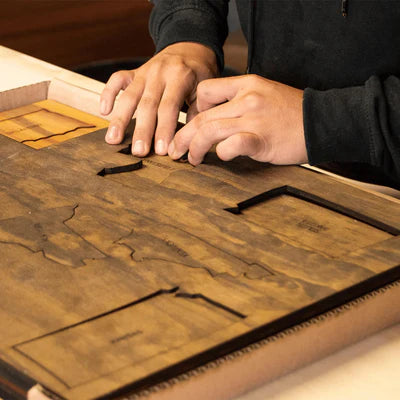
In the realm of tangible art experience, our carefully crafted wooden jigsaw puzzles bring Hokusai's magnum opus to tactile life. The bold linework of his dramatic contrasts translates with a radiance unparalleled, with the grain of wood underscoring the intricate carvings of ink. Engaging with these puzzles is more than pastime; it's an act of tactile scholarship—an intimate embrace of art in its most immediate form.
The Ritual
Assembling a puzzle inspired by Hokusai's wave becomes an act of meditation—a ritual, slow and deliberate. Piece by piece, the wave re-forms under fingertips, from composition’s deceptive calm to the tumultuous crescendo of chaos. Each arrangement is a dance, a graceful reenactment of Hokusai's vision in wooden form, rendering this puzzle not as a hobby but a revered object of contemplation.
Gifting & Collecting
To gift someone a puzzle featuring Hokusai's formidable waves is to share a piece of art history's most poignant moments. For Japan aficionados and those enchanted by myth and history, these puzzles represent heirlooms destined for framed preservation, weaving storied legacies into their surroundings.
Our collection, a curated gallery of Japanese art, extends this narrative across a vast ocean of themes and interpretations. Discover more to explore the lasting influence of Japanese artistry here.
Closing
Within each assembled piece lies a stillness—an elegance wrought from precision and intention. Through these puzzles, the lineage of Japanese woodblock art sustains its voice, whispering eternal truths against both time and tide.
Discover our collection of Japanese wooden puzzles, including The Lantern Ghost by Hokusai and more on What a Woodwork.