


A Tulip, a Butterfly by Dietzsch - Premium Wooden Puzzle
A Tulip, a Butterfly by Dietzsch - Premium Wooden Puzzle
- Regular price
- Price: $115.00
- Regular price
- List Price: $0.00
- Sale price
- Price: $115.00
- Unit price
- per
Key Features:
Key Features:
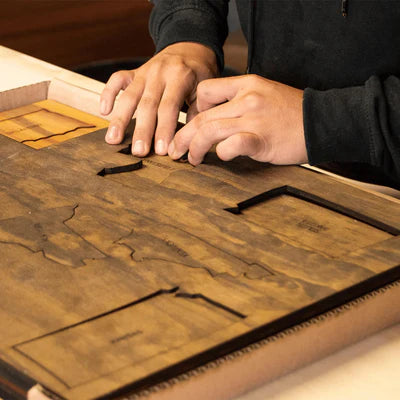
- Premium Quality: Crafted from durable 3mm (.14in) composite wood board for lasting enjoyment.
- Vibrant Imagery: High-resolution UV printing directly on the wood—no paper laminate—for stunning detail and vibrant colors.
- Eco-Conscious: Made with environmentally friendly materials.
- Heirloom Keepsake: Your puzzle arrives beautifully packaged in a handcrafted wooden box, perfect for gifting or storing your masterpiece.
Craftsmanship and Care:
Craftsmanship and Care:
Experience the satisfying click of perfectly interlocking pieces. Our state-of-the-art laser cutting ensures precise fit and a smooth, seamless puzzle-solving experience. The perfect upgrade from cardboard without breaking the bank.
- Natural Laser Residue: A small amount of harmless black residue from the laser cutting process may be present. Simply wipe it away with a damp cloth.
- Hand-Finished Details: Each puzzle board, each wooden box are all carefully hand-stained, painted, and glued.
Satisfaction Guaranteed:
Satisfaction Guaranteed:
We are confident in the quality of our puzzles. If you are not completely satisfied, we offer a full refund or exchange.
PLEASE NOTE:
Each puzzle is crafted to make the most of your chosen size. Artwork may be subtly adjusted to meet our material and production standards while honoring the original work. Planning to frame yours? Email info@whatawoodwork.com for final measurements.
Couldn't load pickup availability
In stock
 PRODUCT DESCRIPTION
A Tulip, a Butterfly of the Species Arctia Caja (Garden Tiger Moth), and a Beetle — Wooden Jigsaw Puzzle
Barbara Regina Dietzsch painted on black. Not as a backdrop — as a choice she made on almost every piece she produced in Nuremberg between roughly 1730 and her death in 1783. The black forces the color to do something it can't do on white: it glows. The tulip in this 1750–60 gouache doesn't sit against a background. It holds its own light source. The garden tiger moth beside it has the same quality. So does the beetle, which most people don't notice until they've been looking for a while.
📖 The Story Behind This Piece
Dietzsch made this around 1750–60, working in opaque and transparent watercolor on parchment with fine lines of metallic gold paint along the edges. The Enlightenment was in full motion in Nuremberg — natural history and scientific illustration were serious pursuits, not decorative ones. The garden tiger moth, Arctia caja, is rendered with the kind of accuracy that would hold up in a modern field guide. The beetle beside the tulip is likely a longhorn. The gold framing lines are almost invisible in reproduction but catch light on the original parchment. The Metropolitan Museum of Art acquired the work in 2024.
Dietzsch came from a family of painters in Nuremberg, and she made a specific decision about her medium: gouache on vellum, always against that black ground. The black wasn't fashionable — it was structural. It forced her to build color in layers from dark to light, which is the opposite of how most watercolorists work. On white paper, you reserve the light. On black, you construct it. Every bright passage in her paintings is earned stroke by stroke, which is why the tulip's white-edged petals read as genuinely luminous rather than simply pale.
UV printing on wood does something specific to this image. On a screen, the black background reads as flat. On the laser-cut MDF, it has texture — the wood grain runs beneath the ink, and when pieces are face-down in the sorting pile, the black sections are nearly indistinguishable from each other. That section of the puzzle will slow you down in a way no digital preview prepares you for. When a piece finally drops into the moth's lower wing and the orange-and-black pattern snaps into place, the weight and click of the piece against 3mm MDF is different from cardboard. The fit stays.
🎁 Who Gets One of These
A few specific people come to mind immediately.
✔️ The natural history print collector — You already own something from the period. Dietzsch was working at the same moment as Ehret and the Bauer brothers, and her black-ground technique puts her in a different category entirely. Twenty-six words.
✔️ The entomologist with a humanities streak — Arctia caja is a moth you know from fieldwork. Seeing it rendered with 1750s gouache on parchment, with that level of wing-pattern accuracy, is genuinely interesting.
✔️ The person who buys art books but not enough wall space — A framed puzzle of this scale fits where a print would. The wooden box stays on the shelf beside it and looks like it belongs there.
✔️ The gift-giver who is tired of giving things that disappear — Dietzsch's work entered the Met's permanent collection last year. Gifting a puzzle of it carries real art-historical weight without requiring explanation.
✔️ The botanical garden regular who also puzzles — The tulip in this image is a mid-18th-century variety, not a modern cultivar. The petal form is noticeably different. Worth assembling slowly.
Mother's Day is the obvious fit here — the spring subject matter and the art-historical substance make it a serious gift, not a seasonal one. Suitable for anniversaries where the recipient is genuinely interested in natural history or fine art illustration. Graduation gifts for art history or biology students with specific taste.
💎 Why This Puzzle Lasts
Most wooden puzzle makers charge $300–$500. The craft justifies it. WAWW gets there differently: direct manufacturing, no wholesale chain, made to order. Same materials, same precision, no markup built in for a retail middleman who never touched the product.
The 3mm MDF core is what separates this from cardboard puzzles you've used before. Cardboard warps with humidity, and pieces that clicked in December don't fit the same way in July. The MDF doesn't move. Pieces cut into it today will still seat cleanly in ten years, or twenty, because the substrate holds its shape without any help from you.
UV printing goes directly onto the wood — no paper laminate bonded on top. Laminate peels at the edges eventually, especially around the cut lines. It also sits slightly above the wood surface, which makes piece edges feel slightly padded and imprecise. Direct UV ink on MDF means the surface is the piece, and the color is in the material rather than sitting on top of it. For an image this dependent on deep blacks and saturated color, that matters.
The grid cut is traditional, meaning the pieces are regular and the connections are clean. No gimmick shapes, no proprietary interlocking system. The result is a puzzle that solves by image and logic rather than by force-fitting unusually shaped pieces. The wooden keepsake box is not packaging — it's part of the object. Most people who frame the puzzle keep the box on the shelf below it. A few keep the puzzle in the box and never frame it at all.
Made to order means no warehouse, no inventory, no puzzle sitting in a box for eight months before it reaches you. Your order goes into production when you place it. That's why the wait is three to four weeks.
🖼️ After You Finish It
Most people frame it. A black-ground botanical at this scale looks deliberately chosen on a wall — which it is. The wooden box ends up nearby, usually on a shelf or side table, and it holds up as an object on its own. Visitors ask about the image first, then about the box, and then someone wants to know who Dietzsch was and why the Metropolitan Museum acquired her work in 2024. That conversation goes further than most people expect.