


Dante and Virgil Hell by Gustave Dore - Wooden Jigsaw Puzzle
Dante and Virgil Hell by Gustave Dore - Wooden Jigsaw Puzzle
- Regular price
- Price: $115.00
- Regular price
- List Price: $0.00
- Sale price
- Price: $115.00
- Unit price
- per
Key Features:
Key Features:
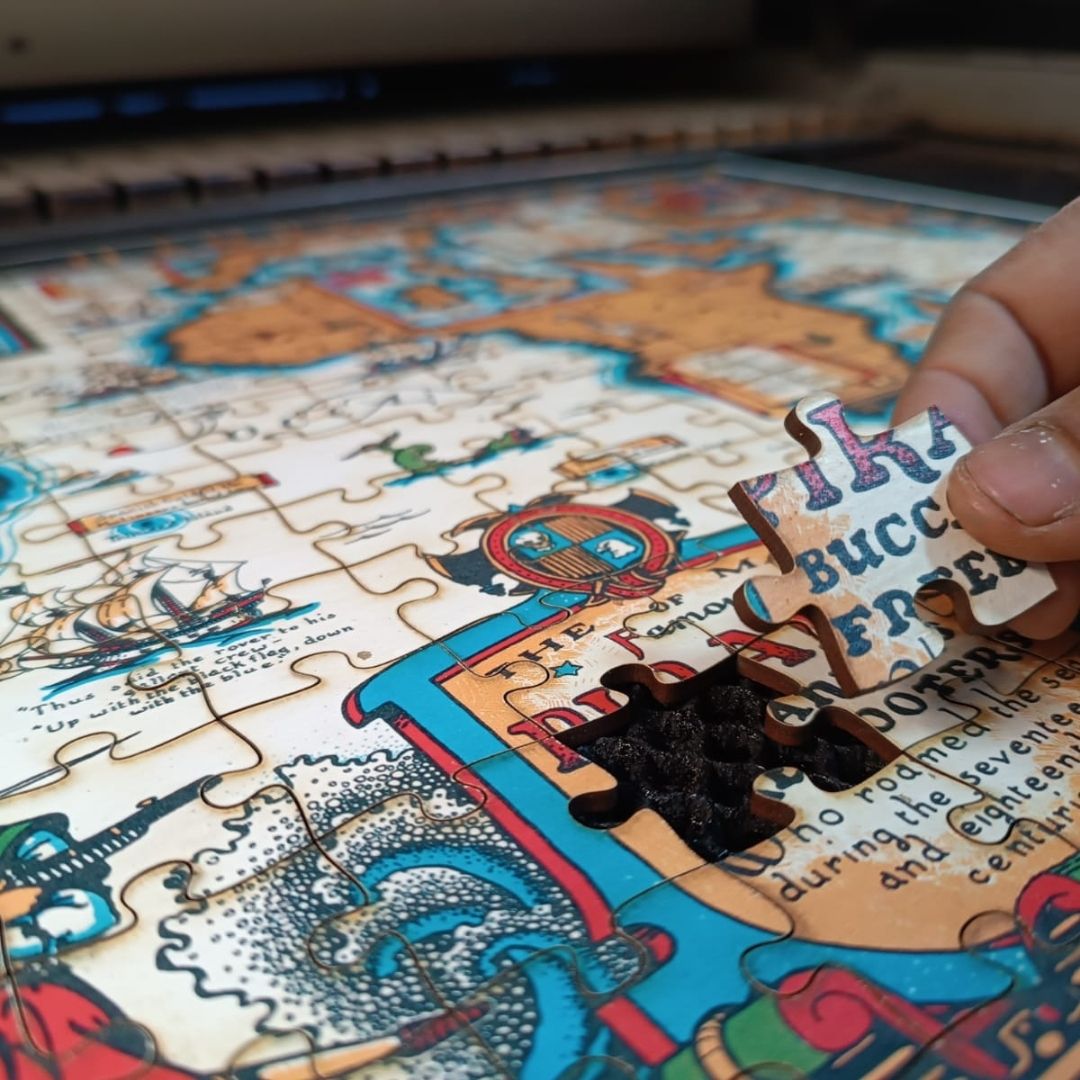
- Premium Quality: Crafted from durable 3mm (.14in) composite wood board for lasting enjoyment.
- Vibrant Imagery: High-resolution UV printing directly on the wood—no paper laminate—for stunning detail and vibrant colors.
- Eco-Conscious: Made with environmentally friendly materials.
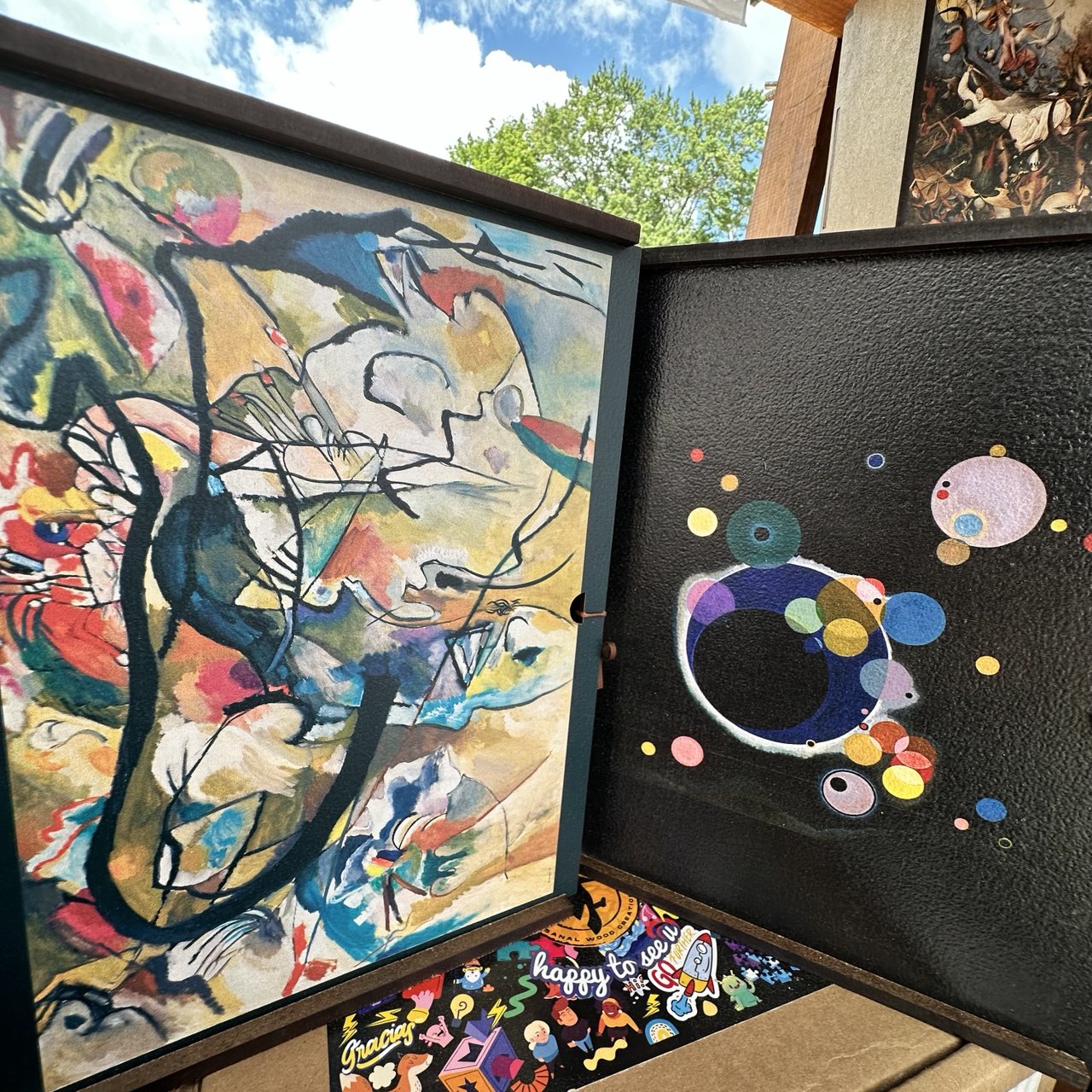
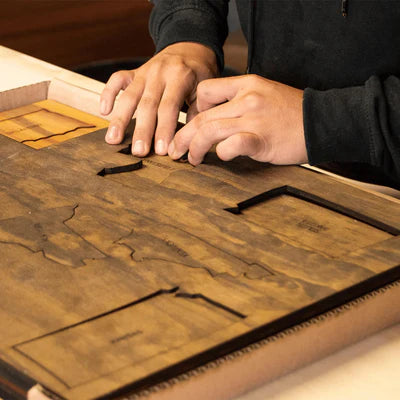
- Heirloom Keepsake: Your puzzle arrives beautifully packaged in a handcrafted wooden box, perfect for gifting or storing your masterpiece.
Craftsmanship and Care:
Craftsmanship and Care:
Experience the satisfying click of perfectly interlocking pieces. Our state-of-the-art laser cutting ensures precise fit and a smooth, seamless puzzle-solving experience. The perfect upgrade from cardboard without breaking the bank.
- Natural Laser Residue: A small amount of harmless black residue from the laser cutting process may be present. Simply wipe it away with a damp cloth.
- Hand-Finished Details: Each puzzle board, each wooden box are all carefully hand-stained, painted, and glued.
Satisfaction Guaranteed:
Satisfaction Guaranteed:
We are confident in the quality of our puzzles. If you are not completely satisfied, we offer a full refund or exchange.
PLEASE NOTE:
Each puzzle is crafted to make the most of your chosen size. Artwork may be subtly adjusted to meet our material and production standards while honoring the original work. Planning to frame yours? Email info@whatawoodwork.com for final measurements.
Couldn't load pickup availability
In stock
 PRODUCT DESCRIPTION
Dante et Virgile en enfer — Gustave Doré — Wooden Jigsaw Puzzle
The Paris Salon of 1861 did not know what to do with this painting. Critics found it too gruesome, too extreme, too literal in its horror. Doré had painted Count Ugolino gnawing on the skull of the man who starved him to death, frozen up to his chest in a lake of ice alongside every traitor in Dante's cosmology. The painting was 315 by 450 centimeters. There was no ignoring it. London and New York loved it. Paris came around eventually.
📖 The Story Behind This Piece
Doré finished this in 1861, working from Canto XXXII of the Divine Comedy, the moment when Dante and Virgil reach Cocytus, the ninth and final circle of Hell. The lake is frozen solid. The traitors are locked into it up to their necks, or their chests, or their faces. Count Ugolino della Gherardesca, one of the most recognizable figures in all of Dante, is there too, teeth in the skull of Archbishop Ruggieri. Doré doesn't soften any of it. The scale of the original canvas, nearly ten feet tall, makes clear he wasn't interested in restraint.
Doré was already the most famous illustrator in Europe when he made this. He didn't need to prove anything commercially. He painted it anyway because he wanted to be taken seriously as a painter, not just a maker of engravings. The Salon's discomfort with the work tells you something: it was too good at what it set out to do. The painting now lives at the Musée du Monastère royal de Brou in Bourg-en-Bresse, where it has been since the Salon stopped looking the other way.
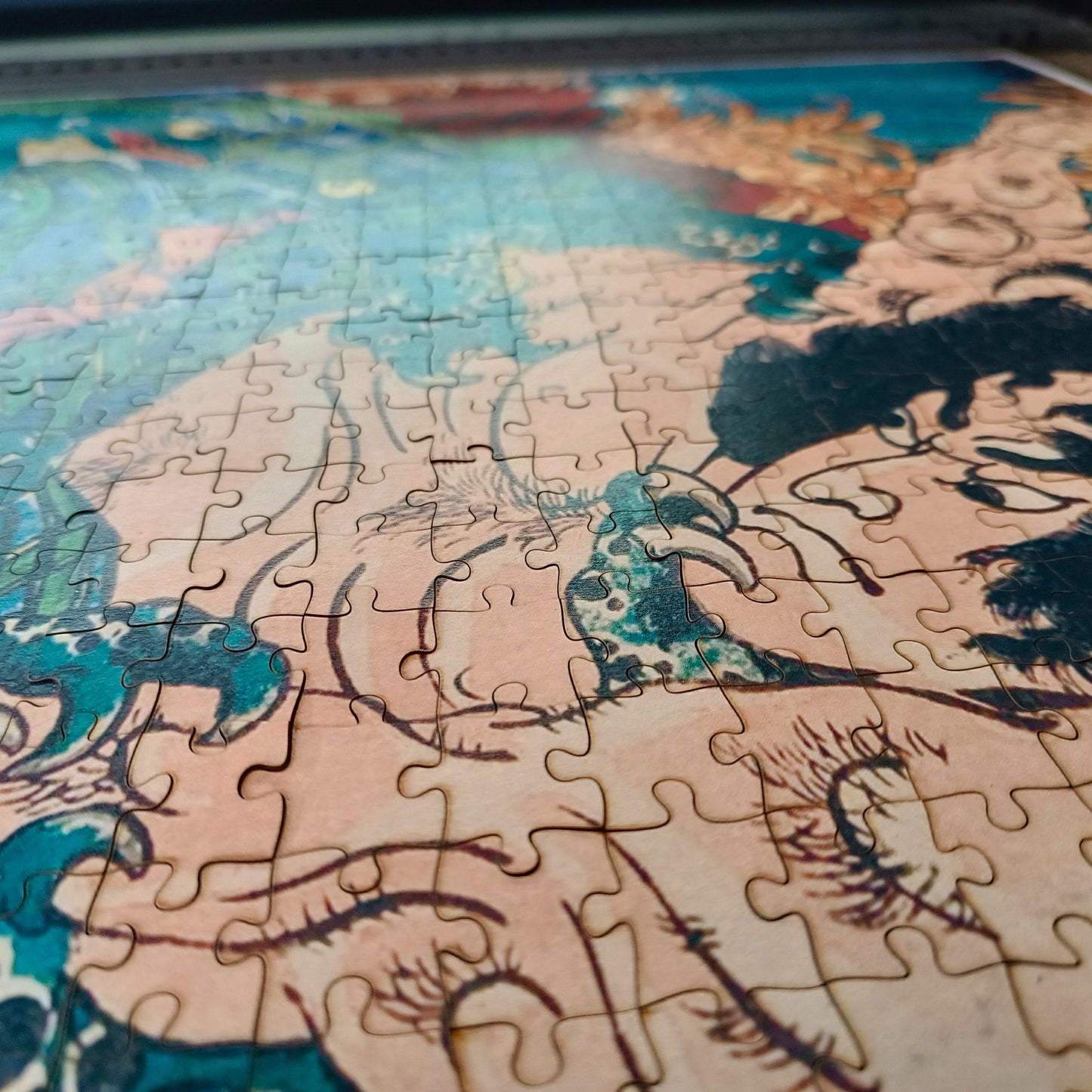
The section that will stop you mid-assembly is the ice. Doré renders Cocytus as a grey-white expanse that reads, in reproduction, as flat. On wood under UV printing, the tonal gradations in that surface open up. You'll find yourself holding a piece that's almost entirely grey and realizing it contains at least four distinct values, each one required to show depth in what is supposed to be a featureless frozen lake. The laser-cut edges stay crisp across every one of those pieces. Nothing bleeds, nothing halos.
🎁 Who Gets One of These
A few specific people keep buying this one.
✔️ The reader who owns an annotated Inferno — You've spent time with Canto XXXII. Ugolino's story is the one you quote. Now there's a version of it that takes up your whole table.
✔️ The collector who gravitates toward Romanticism — You know Doré's work from the engravings but haven't seen the paintings. This is where his ambition is most visible, and most argued over.
✔️ The person who bought the Fuseli print and ran out of wall space — Dark, literary, 19th-century European. Doré fits the shelf. The wooden box fits the aesthetic.
✔️ The academic who teaches medieval literature — A 1861 oil painting of Canto XXXII, laser-cut and UV-printed, in a wooden box, is a better office object than another framed poster of the same engraving everyone already owns.
✔️ The gift-giver who needs something specific — For the person in your life who has read Dante and would never buy something like this for themselves, which is exactly why you should.
Strong fit for Christmas and milestone birthdays. Halloween is obvious but earns it. Also worth noting for graduation gifts to English or art history students.
🧩 Puzzle Specifications
✔️ Precision laser-cut wooden pieces
✔️ 3mm MDF core — rigid, warp-resistant, built to last
✔️ UV printing directly on wood — no paper laminate, no peeling
✔️ Traditional grid-cut design
✔️ Handcrafted wooden keepsake box included
✔️ Made to order — ships in 3–4 weeks
💎 Why This Puzzle Lasts
Comparable wooden puzzles from established brands run $300 to $500. The craft justifies that price. WAWW gets to the same materials through direct manufacturing and no wholesale chain. Made to order, zero warehouse inventory. The savings pass through to you without anything coming out of the object itself.
The 3mm MDF core is what separates a wooden puzzle from a cardboard one in practice, not just in description. Cardboard absorbs humidity, warps at the edges, and starts to delaminate after a few years of storage. MDF doesn't. The pieces click and hold the same way a decade from now as they do on the first assembly. UV printing goes directly onto the wood surface with no paper layer between the ink and the substrate, which means nothing can peel, nothing can bubble, and the color stays put even in direct light over long periods.
The traditional grid cut means every piece has a defined, satisfying snap on connection. No gimmick shapes that make sorting ambiguous. You always know when a piece is right. The wooden keepsake box the puzzle ships in is built to the same standard as the puzzle: solid wood, fitted, something people keep on shelves rather than break down for recycling. Making each puzzle to order means there's no stock sitting in a warehouse slowly degrading. Your copy is cut and printed after you place the order, which is why the wait exists and why it's worth it.
That's a conversation that has been going on since 1321. The painting has been in it since 1861.