


Fishes, crayfishes and crabs by Renard - Premium Wooden Puzzle
Fishes, crayfishes and crabs by Renard - Premium Wooden Puzzle
- Regular price
- Price: $115.00
- Regular price
- List Price: $0.00
- Sale price
- Price: $115.00
- Unit price
- per
Key Features:
Key Features:
- Premium Quality: Crafted from durable 3mm (.14in) composite wood board for lasting enjoyment.
- Vibrant Imagery: High-resolution UV printing directly on the wood—no paper laminate—for stunning detail and vibrant colors.
- Eco-Conscious: Made with environmentally friendly materials.
- Heirloom Keepsake: Your puzzle arrives beautifully packaged in a handcrafted wooden box, perfect for gifting or storing your masterpiece.
Craftsmanship and Care:
Craftsmanship and Care:
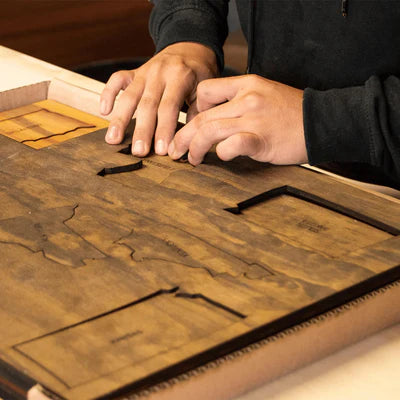
Experience the satisfying click of perfectly interlocking pieces. Our state-of-the-art laser cutting ensures precise fit and a smooth, seamless puzzle-solving experience. The perfect upgrade from cardboard without breaking the bank.
- Natural Laser Residue: A small amount of harmless black residue from the laser cutting process may be present. Simply wipe it away with a damp cloth.
- Hand-Finished Details: Each puzzle board, each wooden box are all carefully hand-stained, painted, and glued.
Satisfaction Guaranteed:
Satisfaction Guaranteed:
We are confident in the quality of our puzzles. If you are not completely satisfied, we offer a full refund or exchange.
PLEASE NOTE:
Each puzzle is crafted to make the most of your chosen size. Artwork may be subtly adjusted to meet our material and production standards while honoring the original work. Planning to frame yours? Email info@whatawoodwork.com for final measurements.
Couldn't load pickup availability
In stock
 PRODUCT DESCRIPTION
Poissons, écrevisses et crabes — Wooden Jigsaw Puzzle
Louis Renard was a spy. Not a naturalist, not a painter — a French Huguenot refugee working for the British Crown out of Amsterdam. In 1719, he published what became the first color-illustrated book of fish ever printed. He'd never been to the Moluccas. Most of the creatures in it don't look quite like anything that actually lives there. One of them is a mermaid.
📖 The Story Behind This Piece
The full title translates to "Fishes, crayfishes and crabs, of diverse colors and extraordinary forms, which are found around the islands of the Moluccas and on the coasts of southern lands." The 100 plates contain 460 hand-colored copper engravings — and Renard published the work without ever leaving the Netherlands.
The book is dedicated to George I, and the title page describes the publisher as "Louis Renard, Agent de Sa Majesté Britannique." His role as spy was apparently not particularly secret — he used it as a marketing tool.
The illustrations came largely from Samuel Fallours, a Dutch soldier stationed in Ambon with the Dutch East India Company, who painted drawings from life over nearly thirty years. Renard copied them, added his editorial hand, and put his name on the title page. The book becomes gradually more surreal as the reader progresses. Approximately 9% of the species depicted are completely fantastical. Across both volumes: 415 fishes, 41 crustaceans, two stick insects, a dugong, and, in a final foldout, a solitary mermaid.
According to ichthyologist Theodore Pietsch, Fallours likely included elements of the fantastical in his drawings in order to attract the European collectors who purchased his works — embellishments ranging from artificially bright and randomly applied colors to total fabrications.
The result was either a masterwork of natural history or an elaborate fabrication — and for 300 years, historians have been unsettled by how little that distinction matters. The book sold. The images stuck.
🧩 Why These Plates Work as Puzzles
Look at the plates shown here. The left plate arranges its fish in a careful column — a rosy hogfish at the top radiating spines, a geometric striped specimen mid-page, a sunburst yellow-and-teal fish near the bottom that no marine biologist has ever fully matched to a living species. The right plate goes stranger: a broad, paddle-shaped creature covered in red and blue spots, a fish with a body like a gourd and stripes that belong on a carnival tent, specimens so boldly colored they look like someone described a reef to an illustrator who had never seen water.
Sorting these pieces is an exercise in controlled disorientation. The colors are vivid and distinct — the reds don't bleed into the oranges, the teals hold their own against the yellows — but Fallours invented his palette freely, which means nothing matches what you expect from memory. You're sorting by a color logic that belongs entirely to one Dutch soldier's imagination, three centuries ago, in a garrison on the other side of the world.
🎁 Who Gets One of These
A few specific kinds of people end up with this one.
✔️ The natural history collector with a thing for early printed science — You know the difference between Seba's Thesaurus and Renard's plates. Owning a piece of this particular book, even at puzzle scale, means something.
✔️ The ichthyologist or marine biologist who can name what Fallours got wrong — The anatomical liberties here aren't random. Spotting them while assembling is its own kind of game.
✔️ The print collector who can't afford a 1719 original — Renard's actual plates sell at auction for thousands per folio. The image on this puzzle is sourced from the same copper engravings.
✔️ The person who already owns one unusual thing on their wall — Not decorating a room from scratch. Adding one more object that requires explanation.
✔️ The gift-giver who's done with giving forgettable things — Specifically buying for someone who knows enough about historical illustration to be genuinely surprised by this one.
Strong occasion fit: a birthday for someone who collects antique prints or natural history books; a retirement gift for a marine scientist or academic historian. The subject is specific enough that it only lands for the right person — which is exactly when it lands hardest.
🧩 Puzzle Specifications
✔️ Precision laser-cut wooden pieces
✔️ 3mm MDF core — rigid, warp-resistant, built to last
✔️ UV printing directly on wood — no paper laminate, no peeling
✔️ Traditional grid-cut design
✔️ Handcrafted wooden keepsake box included
✔️ Made to order — ships in 3–4 weeks
💎 Why This Puzzle Lasts
Wooden puzzles from the brands you've probably seen run $300 to $500. The craft justifies it. WAWW gets to the same materials through direct manufacturing and no wholesale chain — made to order, no warehouse, no markup passed through three hands before yours. The price difference is structural, not a corner cut.
The 3mm MDF core is why a piece picked up in ten years still clicks into place cleanly. Cardboard absorbs humidity and warps; MDF doesn't. The rigidity also means the pieces separate cleanly when you're sorting — no soft edges, no flex. UV printing goes directly onto the wood surface, with no paper laminate sitting between the image and the substrate. On a piece with Renard's saturated hand-colored palette, that matters: the color is bonded to the material, not sitting on top of it waiting to peel.
The traditional grid cut keeps solving honest — no arbitrary piece shapes, no gimmicks, just the image broken into its natural components. After you're done, the pieces go back into a handcrafted wooden box that's built to keep them. Most people keep the box on a shelf. It holds up to that. Made to order means your puzzle doesn't exist until you buy it — no inventory sitting in a climate-controlled warehouse degrading slowly. The three-to-four week lead time is the cost of that, and most buyers say it's worth it.