


Golden Pheasant in the Snow by Jakuchū - Wooden Jigsaw Puzzle
Golden Pheasant in the Snow by Jakuchū - Wooden Jigsaw Puzzle
- Regular price
- Price: $115.00
- Regular price
- List Price: $0.00
- Sale price
- Price: $115.00
- Unit price
- per
Key Features:
Key Features:
- Premium Quality: Crafted from durable 3mm (.14in) composite wood board for lasting enjoyment.
- Vibrant Imagery: High-resolution UV printing directly on the wood—no paper laminate—for stunning detail and vibrant colors.
- Eco-Conscious: Made with environmentally friendly materials.
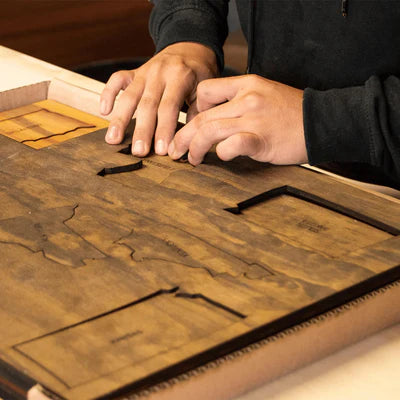
- Heirloom Keepsake: Your puzzle arrives beautifully packaged in a handcrafted wooden box, perfect for gifting or storing your masterpiece.
Craftsmanship and Care:
Craftsmanship and Care:
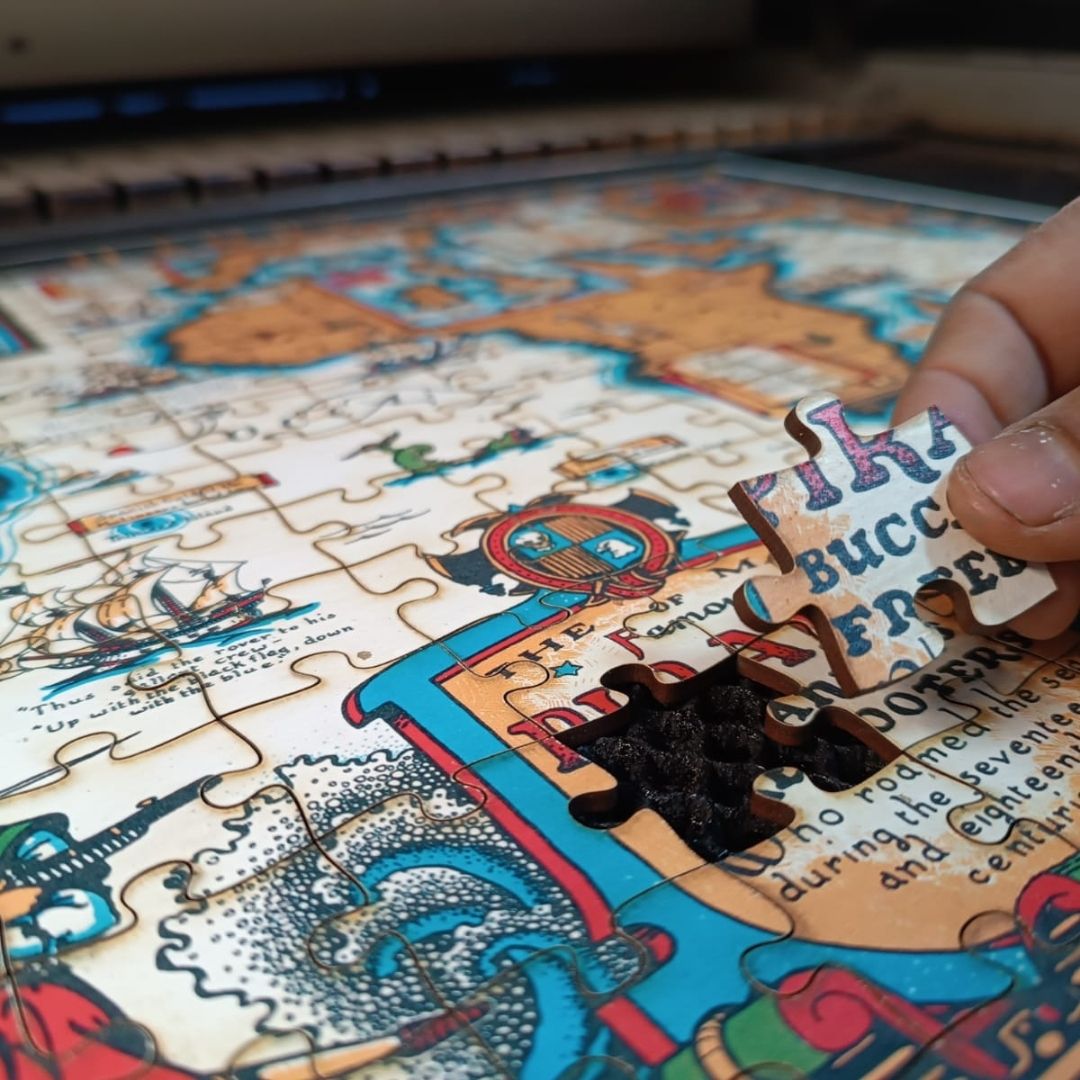
Experience the satisfying click of perfectly interlocking pieces. Our state-of-the-art laser cutting ensures precise fit and a smooth, seamless puzzle-solving experience. The perfect upgrade from cardboard without breaking the bank.
- Natural Laser Residue: A small amount of harmless black residue from the laser cutting process may be present. Simply wipe it away with a damp cloth.
- Hand-Finished Details: Each puzzle board, each wooden box are all carefully hand-stained, painted, and glued.
Satisfaction Guaranteed:
Satisfaction Guaranteed:
We are confident in the quality of our puzzles. If you are not completely satisfied, we offer a full refund or exchange.
PLEASE NOTE:
Each puzzle is crafted to make the most of your chosen size. Artwork may be subtly adjusted to meet our material and production standards while honoring the original work. Planning to frame yours? Email info@whatawoodwork.com for final measurements.
Couldn't load pickup availability
In stock
 PRODUCT DESCRIPTION
Golden Pheasant in the Snow — Wooden Jigsaw Puzzle
Itō Jakuchū painted the snow from behind. The back-coloring technique he used on this scroll — applying pigment to the reverse side of the silk — creates a glow that no front-facing brushstroke can replicate. The snow doesn't sit on the surface. It comes from within it. That's not a metaphor. That's the actual physics of how he made it.
📖 The Story Behind This Piece
"Golden Pheasants in Snow" is the 19th of 30 scrolls in Jakuchū's Colorful Realm of Living Beings, painted between 1761 and 1765 on silk. Two golden pheasants sit on a snow-covered cypress branch, camellias in bloom below them — winter and spring occupying the same frame, which is either impossible or exactly the point. The complete series now belongs to the Museum of the Imperial Collections in Tokyo, donated to Shōkoku-ji Temple in Kyoto by the artist himself.
Jakuchū spent most of his adult life running his family's produce business in Kyoto. He painted anyway, and when he finally devoted himself fully to art, he did something merchants understand well: he studied his inventory. He kept a private menagerie of birds so he could observe them directly. The pheasant's plumage in this scroll, those layered reds and golds, comes from that kind of sustained looking. Not imagination. Accumulation.
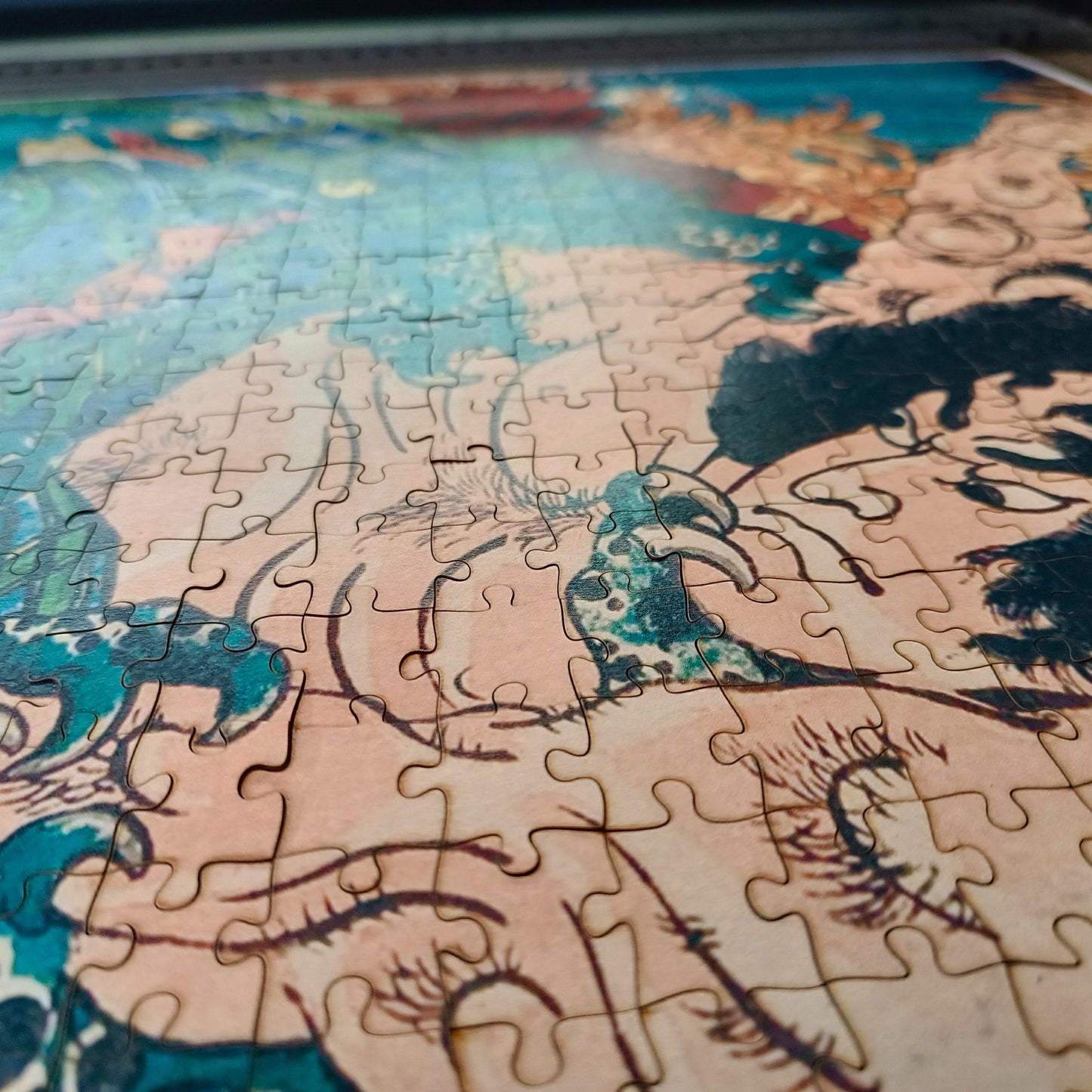
The camellias at the bottom of the composition are where assembly gets interesting. In a digital file, the red petals read as flat shapes against white snow. On wood with UV printing, the ink sits directly in the grain, and the contrast between the warm red and the cool ground gains a texture that a screen simply cannot produce. When you're sorting those camellia pieces, you'll notice that what looked like two or three tones of red in the preview image is actually closer to eight.
🎁 Who Gets One of These
A few specific people keep ending up with this one.
✔️ The collector who owns Japanese woodblock prints — You already know Hiroshige's snow scenes. Jakuchū is the less-traveled road, and this scroll is a strong argument for taking it.
✔️ The museum member who visited the Sannomaru Shozokan — You've seen the Colorful Realm series in person or spent real time with the catalog. Reassembling scroll 19 by hand is a different kind of engagement with it.
✔️ The birder with a serious life list — Golden pheasants are native to China's mountainous regions and notoriously difficult to observe in the wild. Jakuchū studied his for months. The plumage detail reflects that.
✔️ The person who gives art books at the holidays but wants something people actually use — A puzzle of this image gets handled in a way a monograph doesn't. The interaction is slower and more physical.
✔️ The adult child shopping for a parent who grew up in Japan — Jakuchū is genuinely beloved there in a way that doesn't always translate overseas. For someone who knows this work, the recognition lands differently.
🧩 Puzzle Specifications
✔️ Precision laser-cut wooden pieces
✔️ 3mm MDF core — rigid, warp-resistant, built to last
✔️ UV printing directly on wood — no paper laminate, no peeling
✔️ Traditional grid-cut design
✔️ Handcrafted wooden keepsake box included
✔️ Made to order — ships in 3–4 weeks
💎 Why This Puzzle Lasts
Most wooden puzzle makers charge $300–$500. The craft justifies that. We get to the same place differently: direct manufacturing, no wholesale chain, no retailer margin, made one at a time. The materials are the same. The markup isn't there.
The 3mm MDF core is why a finished puzzle still fits together correctly after a decade on a shelf. Cardboard compresses, warps with humidity, and eventually the pieces stop clicking. MDF doesn't do any of that. When you pick up a piece, it has weight. When it clicks into place, you feel it.
UV printing bonds ink directly to the wood surface rather than printing onto paper that gets laminated over it. No laminate means no peeling at the corners, no yellowing, no loss of color fidelity over time. For an image built around the specific reds and golds of pheasant plumage against white snow, color stability isn't a small thing.
The traditional grid cut means every piece has a clean, predictable shape. No trick cuts, no whimsy pieces shaped like pheasants. The solving logic is pure. When you're working through 1,000 pieces of this image, that clarity is what keeps you oriented. The wooden keepsake box is made to the same standard as the puzzle — dovetail joinery, not a cardboard sleeve. Most people keep the box out after assembly.
Made to order means your puzzle doesn't exist until you order it. No warehouse, no sitting in a box for eight months. Production takes 3–4 weeks, and the wait is the reason the quality is consistent.
The 300-piece, 15"x23" starts at $115. The 1000-piece, 23"x31" runs $170.
🖼️ After You Finish It
Most people frame it. The wooden box ends up nearby on a shelf, which is not a bad outcome for what most people consider the packaging. Visitors notice the image first — the pheasants, the snow, the camellias — and then ask which artist. Jakuchū is one of those names that prompts a genuine conversation. The Colorful Realm series took four years to paint and has been held in the same collection for over two centuries. That context tends to surface when you've spent real time rebuilding the image yourself.