


The Hell Courtesan — Kawanabe Kyosai's Jigoku Dayu Wooden Puzzle
The Hell Courtesan — Kawanabe Kyosai's Jigoku Dayu Wooden Puzzle
- Regular price
- Price: $115.00
- Regular price
- List Price: $0.00
- Sale price
- Price: $115.00
- Unit price
- per
Key Features:
Key Features:
- Premium Quality: Crafted from durable 3mm (.14in) composite wood board for lasting enjoyment.
- Vibrant Imagery: High-resolution UV printing directly on the wood—no paper laminate—for stunning detail and vibrant colors.
- Eco-Conscious: Made with environmentally friendly materials.
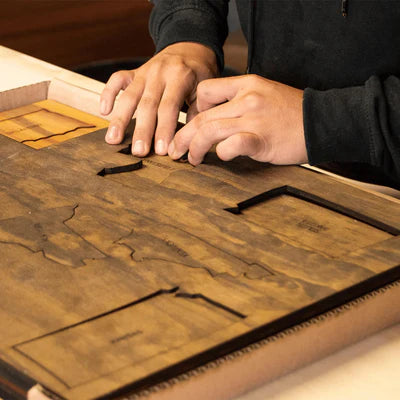
- Heirloom Keepsake: Your puzzle arrives beautifully packaged in a handcrafted wooden box, perfect for gifting or storing your masterpiece.
Craftsmanship and Care:
Craftsmanship and Care:
Experience the satisfying click of perfectly interlocking pieces. Our state-of-the-art laser cutting ensures precise fit and a smooth, seamless puzzle-solving experience. The perfect upgrade from cardboard without breaking the bank.
- Natural Laser Residue: A small amount of harmless black residue from the laser cutting process may be present. Simply wipe it away with a damp cloth.
- Hand-Finished Details: Each puzzle board, each wooden box are all carefully hand-stained, painted, and glued.
Satisfaction Guaranteed:
Satisfaction Guaranteed:
We are confident in the quality of our puzzles. If you are not completely satisfied, we offer a full refund or exchange.
PLEASE NOTE:
Each puzzle is crafted to make the most of your chosen size. Artwork may be subtly adjusted to meet our material and production standards while honoring the original work. Planning to frame yours? Email info@whatawoodwork.com for final measurements.
Couldn't load pickup availability
In stock
 PRODUCT DESCRIPTION
Jigoku Dayu (Hell Courtesan) — Wooden Jigsaw Puzzle
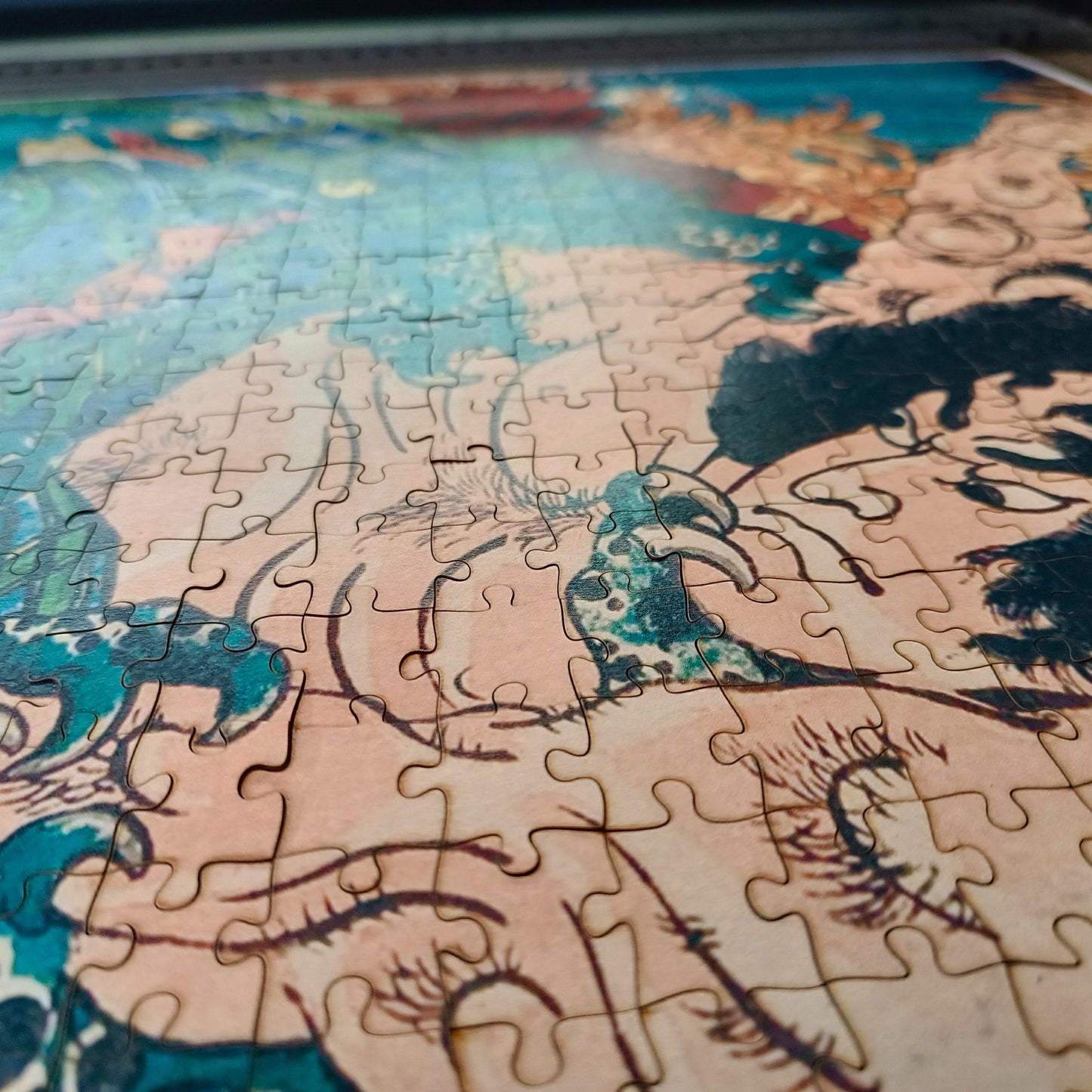
Her kimono is painted with hell. Not as metaphor — as literal illustration. Kawanabe Kyosai covered the fabric in scenes from Buddhist damnation: the King of Hell presiding, sinners at their fate, the whole cosmology worn as clothing. Jigoku Dayu, the courtesan who found enlightenment through a Zen monk named Ikkyū, is dreaming. The skeletons around her are gleeful.
📖 The Story Behind This Piece
Kyosai made this woodblock print in 1874, three years into the Meiji period, when Japan was dismantling the social order that had defined it for two centuries. Jigoku Dayu — a real figure from folklore, a courtesan who studied Zen under the monk Ikkyū Sōjun — wears a kimono that maps the Buddhist afterlife in exquisite detail. King Enma appears on the hem. Frolicking skeletons populate the border. The whole image runs on the Buddhist concept of mujō: impermanence, the inseparability of beauty and decay. Kyosai wasn't being morbid. He was being precise.
Kyosai trained under Utagawa Kuniyoshi at age seven, then spent decades developing a style sharp enough to get him arrested. The Meiji government jailed him briefly in 1870 for caricatures deemed politically subversive. He kept drawing. When the British architect Josiah Conder asked to study under him in 1881, Kyosai accepted. The nickname "Demon of Painting" wasn't reverence — it was acknowledgment that he worked at a frequency most artists couldn't reach.
The kimono is where the puzzle gets interesting. In a digital reproduction, the hellscape on the fabric reads as pattern. On a UV-printed wooden piece in your hand, you start to see Enma's expression, the individual sinners, the linework Kyosai used to separate figure from ground. When you're sorting dark reds and blacks in the lower border, you'll notice the pieces aren't uniform — the color shifts within single pieces in ways the screen flattens entirely. The ink sits on wood grain here, not paper. It doesn't glow. It settles.
🎁 Who Gets One of These
A specific gift for a specific kind of person. Here's who actually buys this one.
✔️ The Japanese art collector who owns at least one actual ukiyo-e print — You know Kyosai's name already. Spending time rebuilding this image piece by piece is a different relationship with the work than hanging it.
✔️ The museum-goer who made the trip to the Japan Society or a major Asian art retrospective — You've seen Meiji-era work in person and know what the line quality actually looks like. The UV print on wood gets closer than most reproductions.
✔️ The folklore reader who has a shelf of Lafcadio Hearn — Jigoku Dayu sits squarely in the tradition Hearn spent his life translating. The image rewards that background.
✔️ The person who finds memento mori aesthetics genuinely beautiful rather than morbid — Skeletons as subjects of humor and grace, not horror. Kyosai's version of this is among the best ever made.
✔️ The gift-giver who is done buying things that disappear — A wooden puzzle in a handcrafted box doesn't get thrown out. It ends up on a shelf or framed, and the box stays too.
Works as a gift for New Year's, when the Buddhist themes of impermanence and renewal land with particular weight. Strong for milestone birthdays where the recipient is the kind of person who actually knows what ukiyo-e means.
🧩 Puzzle Specifications
✔️ Precision laser-cut wooden pieces
✔️ 3mm MDF core — rigid, warp-resistant, built to last
✔️ UV printing directly on wood — no paper laminate, no peeling
✔️ Traditional grid-cut design
✔️ Sizes: 15"x23", 18"x24", 23"x31"
✔️ Piece counts: 300–1000
✔️ Handcrafted wooden keepsake box included
✔️ Made to order — ships in 3–4 weeks
💎 Why This Puzzle Lasts
Wooden puzzle makers who charge $300–$500 are not overcharging. The craft justifies it. WAWW gets to the same place differently: direct manufacturing, no wholesale chain, no warehouse sitting on inventory. Same materials, no markup passed through three sets of hands.
The 3mm MDF core is why the pieces still click cleanly after years of storage. Cardboard compresses and warps; MDF holds its geometry. You feel it when a piece seats — there's a solidity to it that cardboard never achieves. UV printing bonds ink directly to the wood surface rather than to a paper laminate glued on top. No laminate means no peeling at the edges after repeated assembly. The image stays exactly as printed.
The traditional grid cut produces clean, predictable connections — no novelty shapes competing with the image for attention. Kyosai's linework is the point; the cut doesn't fight it. The keepsake box is built from the same quality of wood as the puzzle itself, sized to hold the finished pieces. Most people keep it. After the puzzle is framed or stored, the box finds a shelf. Made to order means your puzzle doesn't exist until you buy it — no warehouse, no overproduction, no fading stock piece that's been handled before it reaches you.
The 300-piece, 15"x23" starts at $115. The 1000-piece, 23"x31" runs $170.
🖼️ After You Finish It
Most people frame it. The image holds the wall well — those reds and blacks read from across a room in a way they don't on a screen. The wooden box ends up nearby, usually on a shelf, and it's the box that starts conversations first. Jigoku Dayu has been part of Japanese visual culture for over a thousand years, and Kyosai's 1874 version is the one scholars still argue about.