
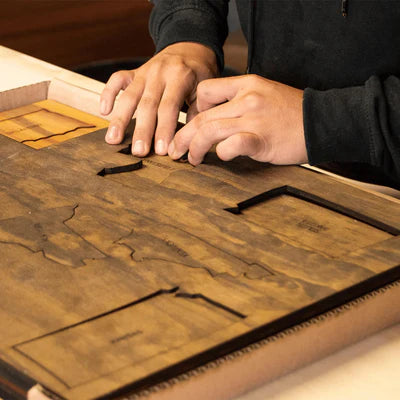


Belling the Cat — Kawanabe Kyosai Wooden Puzzle
Belling the Cat — Kawanabe Kyosai Wooden Puzzle
- Regular price
- Price: $115.00
- Regular price
- List Price: $0.00
- Sale price
- Price: $115.00
- Unit price
- per
Key Features:
Key Features:
- Premium Quality: Crafted from durable 3mm (.14in) composite wood board for lasting enjoyment.
- Vibrant Imagery: High-resolution UV printing directly on the wood—no paper laminate—for stunning detail and vibrant colors.
- Eco-Conscious: Made with environmentally friendly materials.
- Heirloom Keepsake: Your puzzle arrives beautifully packaged in a handcrafted wooden box, perfect for gifting or storing your masterpiece.
Craftsmanship and Care:
Craftsmanship and Care:
Experience the satisfying click of perfectly interlocking pieces. Our state-of-the-art laser cutting ensures precise fit and a smooth, seamless puzzle-solving experience. The perfect upgrade from cardboard without breaking the bank.
- Natural Laser Residue: A small amount of harmless black residue from the laser cutting process may be present. Simply wipe it away with a damp cloth.
- Hand-Finished Details: Each puzzle board, each wooden box are all carefully hand-stained, painted, and glued.
Satisfaction Guaranteed:
Satisfaction Guaranteed:
We are confident in the quality of our puzzles. If you are not completely satisfied, we offer a full refund or exchange.
PLEASE NOTE:
Each puzzle is crafted to make the most of your chosen size. Artwork may be subtly adjusted to meet our material and production standards while honoring the original work. Planning to frame yours? Email info@whatawoodwork.com for final measurements.
Couldn't load pickup availability
In stock
 PRODUCT DESCRIPTION
Isoho Monogatari no Uchi, Nezumi no Sōdan no Hanashi "The Mice in Council"— Wooden Jigsaw Puzzle
Kawanabe Kyosai painted rats holding a political meeting. The year was 1873. Japan was in the middle of dismantling its entire social order, and the question on the floor was the same one from Aesop: who bells the cat? Nobody volunteered then either. Kyosai knew his audience would get the joke.
📖 The Story Behind This Piece
Between 1873 and 1875, Kyosai produced a series of woodblock prints adapting Aesop's Fables for a Japanese public newly flooded with Western literature. Aesop arrived in Japan via Meiji-era translation programs, part of a deliberate government push to absorb foreign culture wholesale. Kyosai used the fable of Belling the Cat — rats debating who will volunteer to put a bell on their predator, with no takers — to say something pointed about the Popular Rights Movement and the officials who wouldn't act on it. The rats are rendered with genuine urgency. The cat is never shown.
Kyosai trained under the Kano school, which meant years of disciplined brushwork in the classical Chinese-influenced tradition. He broke from it deliberately. The ukiyo-e energy in his figures — the loose, kinetic line, the humor running beneath the surface — was a choice, not a drift. By the time he made the Isoho Monogatari series, he was fluent in two visual languages and used that fluency to say things a more decorous artist couldn't.
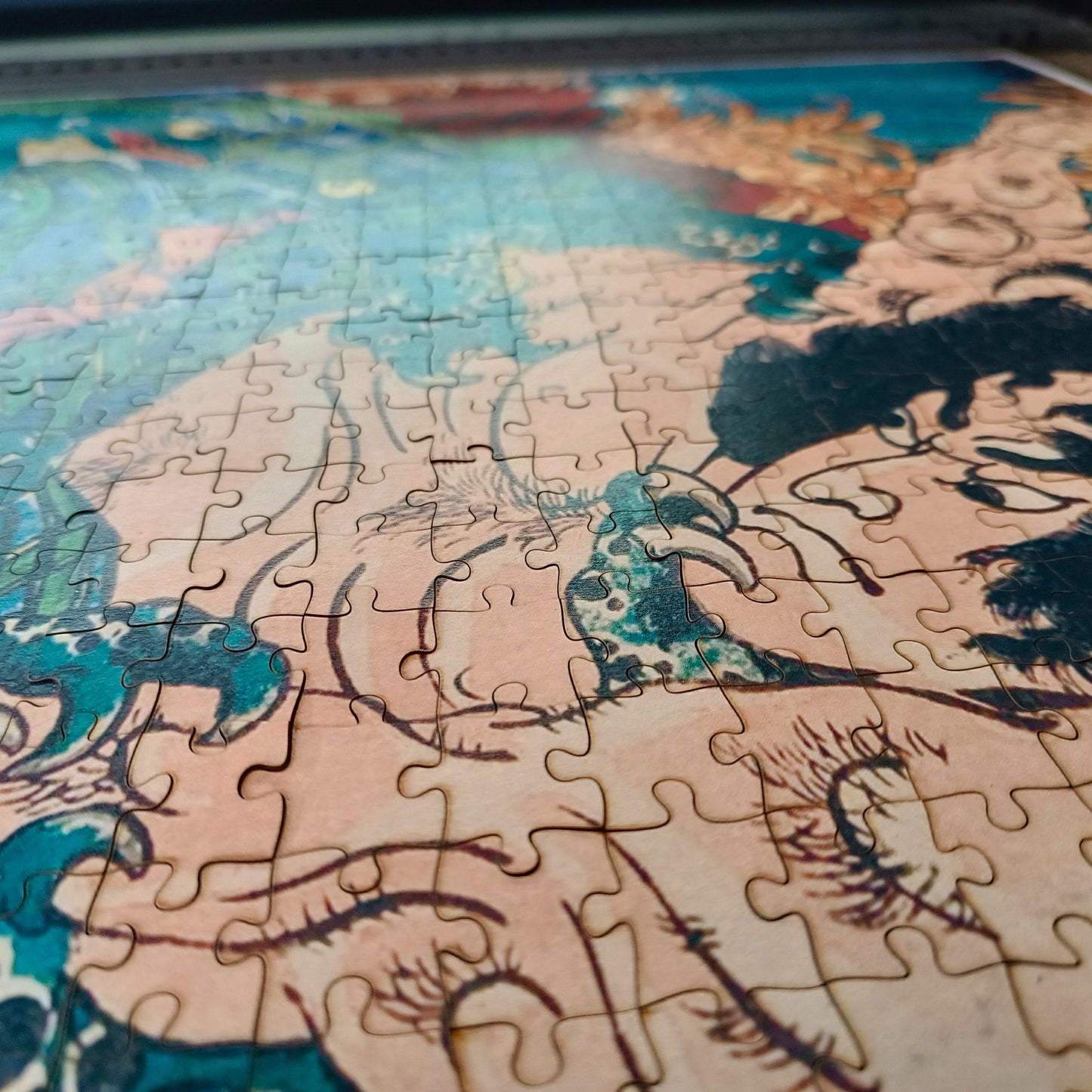
The rats themselves are the puzzle's hardest section. Kyosai packed the composition with overlapping figures in similar dark tones, and on wood with UV printing, each robe and tail registers as a distinct texture rather than a flat color field. Paper laminate would blur that distinction. The ink sits directly in the wood grain here, and when a cluster of three nearly identical rat figures finally resolves into separate bodies, you can see exactly what Kyosai was doing with the crowd dynamic. He made them look alike on purpose.
🖼️ Need translation?
It's Aesop's classic fable of Belling the Cat — one of the most universally recognized moral tales ever written. The story: mice gather in a grand council to solve their greatest problem — the cat. Someone proposes the brilliant idea of hanging a bell around the cat's neck so they'll always hear it coming. The room erupts in approval. Then one old mouse asks: "But who among us will actually put the bell on the cat?" Silence. Nobody volunteers. The moral: it's easy to propose bold solutions, but far harder to act on them.
Title Cartouche (Right Oval)
-
Series Title: 伊蘇普物語之内 (Isoho Monogatari no Uchi) — "Within the Tales of Aesop"
-
Print Title: 鼠の評議の話 (Nezumi no Hyōgi no Hanashi) — "The Story of the Council of Mice"
Main Narrative Text (Top Left Box)
This text tells the classic story in the formal, classical Japanese of the Meiji era:
"Once, mice were being constantly harassed and tormented by a cat, to the point where they could not even step outside. They gathered their companions together to discuss what should be done. A young mouse stepped forward and said, 'To ensure our peace of mind, let us attach a bell to the cat's neck. That way, whenever the cat comes running, we will hear the bell and can escape immediately.'
The entire group was overjoyed and celebrated this plan. However, an old mouse then spoke up: 'This is an excellent, excellent plan. But among our companions, who shall we have perform the deed of attaching the bell to the cat's neck?' Hearing this, they all looked away from one another, and not a single mouse stepped forward to do it. This shows that no matter how good a plan is, if the execution is too difficult, it cannot save you."
Dialogue and Labels
Kyōsai added humorous details to the characters:
-
Central Mouse: Sitting on a blue cushion, he is labeled 議長 (Gichō), which means "Chairman."
-
Mouse on the Left (holding the red cord): He is the young mouse making the proposal. His dialogue says something like, "Well, something difficult has been proposed!" as he realizes the magnitude of the task.
-
Mice on the Right: They are murmuring about their fear, saying things like, "The cat is terrifying..." and wondering exactly where or how they could possibly attach the bell without getting caught.
🎁 Who Gets One of These
A few specific kinds of people keep ordering this one.
✔️ The collector who already owns a Kyosai print — You know his line work. Spending time with it piece by piece, at this scale, is different from hanging it.
✔️ The art historian who studies Meiji-period Japan — The Isoho Monogatari series sits at an exact crossroads of Eastern and Western influence, 1873, with a political argument built into the fable itself.
✔️ The literary person who knows their Aesop — The fable has been retold for 2,500 years. Kyosai's version, with its Meiji political subtext, is the most specific and most pointed rendition of it.
✔️ The woodblock print enthusiast who works in a different medium — The UV-on-wood printing preserves the grain relationship that makes this feel like what it is, not a reproduction of one.
✔️ The gift-giver looking for something with actual content — Not a decorative object. A political cartoon from 1873 Japan, made into something you can hold.
Works for birthdays and retirement gifts when the recipient has a real interest in Japanese art, Asian history, or satirical illustration. Skip the anniversary angle unless you know the couple well.
🧩 Puzzle Specifications
✔️ Precision laser-cut wooden pieces
✔️ 3mm MDF core — rigid, warp-resistant, built to last
✔️ UV printing directly on wood — no paper laminate, no peeling
✔️ Traditional grid-cut design
✔️ Handcrafted wooden keepsake box included
✔️ Made to order — ships in 3–4 weeks
💎 Why This Puzzle Lasts
Most wooden puzzle makers charge $300 to $500. The craft justifies the price. WAWW gets there differently: direct manufacturing, no wholesale chain, made to order only. Same materials. The savings come from structure, not shortcuts.
The 3mm MDF core holds its shape. Cardboard puzzles warp after a few years, especially in variable humidity. MDF doesn't, which means the pieces still click together with the same resistance in twenty years. UV printing bonds ink directly into the wood surface rather than applying a paper laminate on top. No laminate means no peeling at the edges, and no color shift as the paper degrades. What you see in the Kyosai now is what you'll see in a decade.
The traditional grid cut produces clean, tactile connections. Pieces lock without forcing, release without sticking. When you finish, the wooden keepsake box is built for actual storage, not just first delivery. People keep it. Some frame the puzzle; others keep it assembled in the box and return to it. Every puzzle is made to order, which is why there's a 3-to-4-week wait. Nothing sits in a warehouse. Yours is cut after you place the order.
The 300-piece, 15"x23" starts at $115. The 1000-piece, 23"x31" runs $170.