


Japanese Warrior by T. Yoshitoshi - Premium Wooden Puzzle
Japanese Warrior by T. Yoshitoshi - Premium Wooden Puzzle
- Regular price
- Price: $115.00
- Regular price
- List Price: $0.00
- Sale price
- Price: $115.00
- Unit price
- per
Key Features:
Key Features:
- Premium Quality: Crafted from durable 3mm (.14in) composite wood board for lasting enjoyment.
- Vibrant Imagery: High-resolution UV printing directly on the wood—no paper laminate—for stunning detail and vibrant colors.
- Eco-Conscious: Made with environmentally friendly materials.
- Heirloom Keepsake: Your puzzle arrives beautifully packaged in a handcrafted wooden box, perfect for gifting or storing your masterpiece.
Craftsmanship and Care:
Craftsmanship and Care:
Experience the satisfying click of perfectly interlocking pieces. Our state-of-the-art laser cutting ensures precise fit and a smooth, seamless puzzle-solving experience. The perfect upgrade from cardboard without breaking the bank.
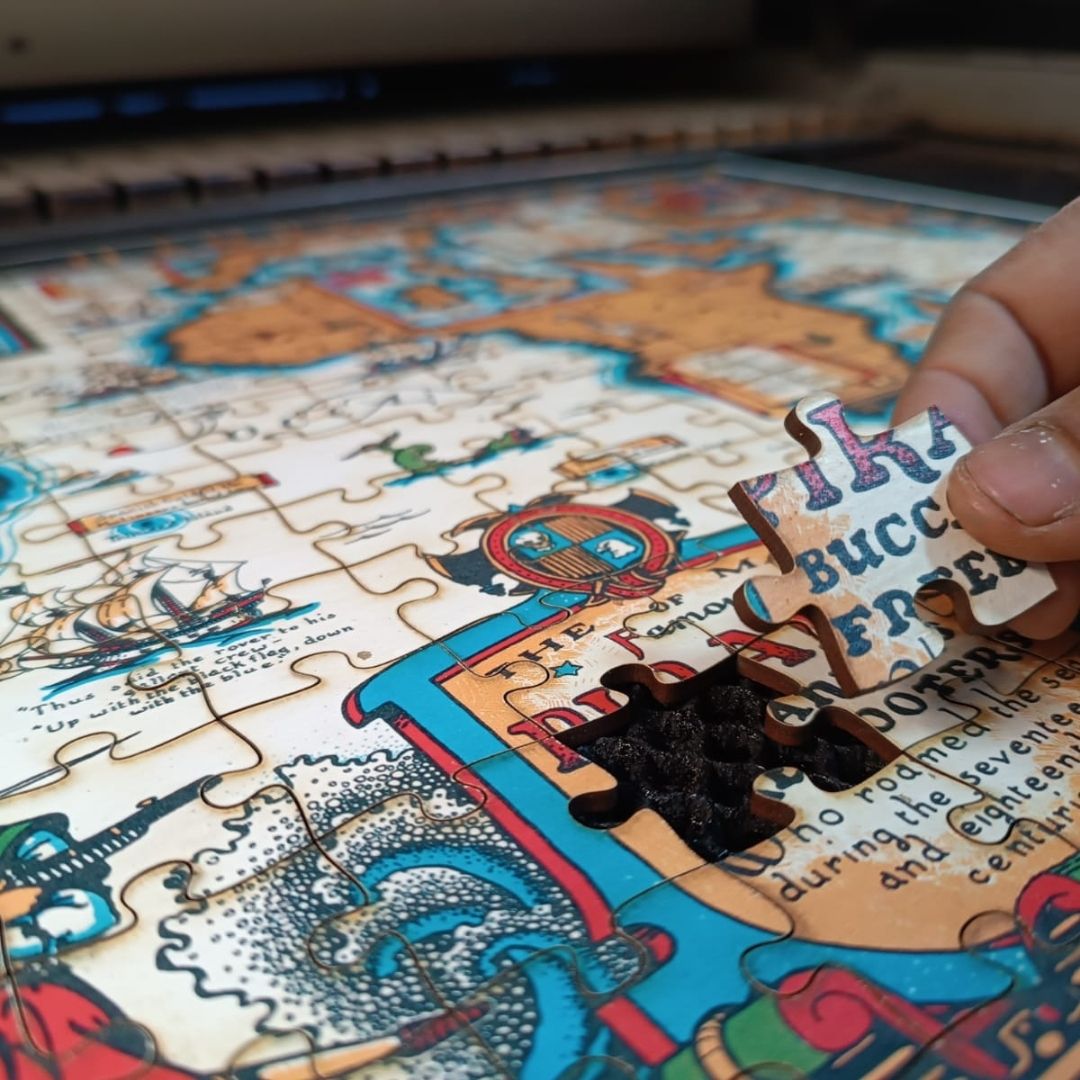
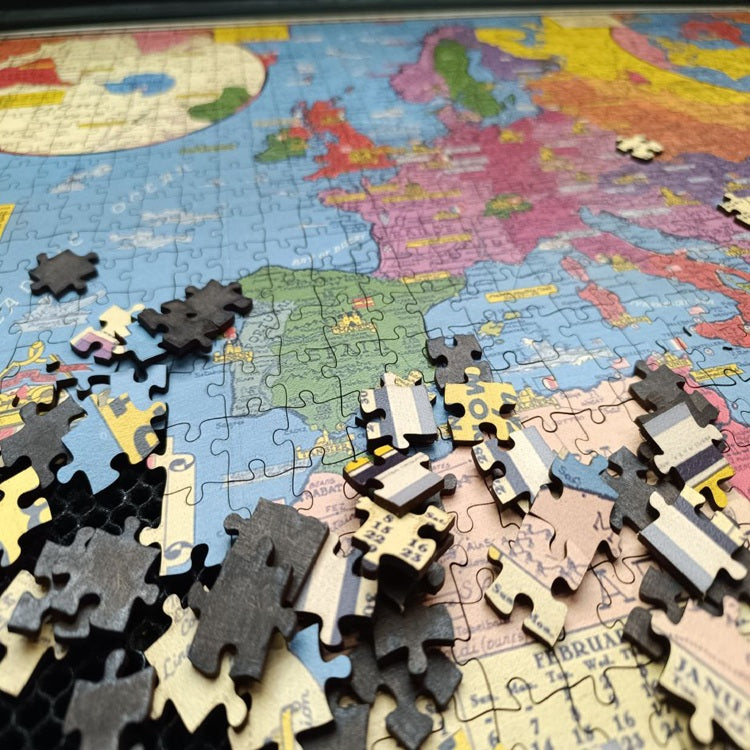
- Natural Laser Residue: A small amount of harmless black residue from the laser cutting process may be present. Simply wipe it away with a damp cloth.
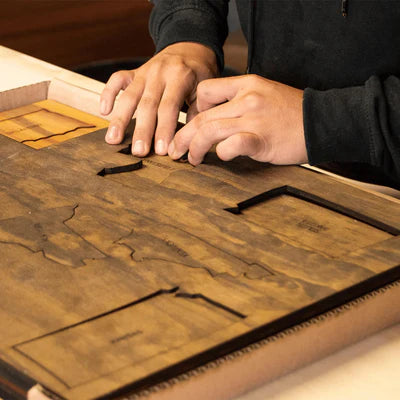
- Hand-Finished Details: Each puzzle board, each wooden box are all carefully hand-stained, painted, and glued.
Satisfaction Guaranteed:
Satisfaction Guaranteed:
We are confident in the quality of our puzzles. If you are not completely satisfied, we offer a full refund or exchange.
PLEASE NOTE:
Each puzzle is crafted to make the most of your chosen size. Artwork may be subtly adjusted to meet our material and production standards while honoring the original work. Planning to frame yours? Email info@whatawoodwork.com for final measurements.
Couldn't load pickup availability
In stock
 PRODUCT DESCRIPTION
Komagine Hachibyoe, Pointing a Gun at the Viewer — Wooden Jigsaw Puzzle
Yoshitoshi made this print in 1868 while a civil war was actively being fought outside his door. The Boshin War was underway, censors were watching, and depicting contemporary violence was illegal. So he dressed his subjects in historical warrior costumes. Komagine Hachibyoe, dead for centuries, aims a matchlock gun at your face. Everyone understood exactly who he really meant.
📖 The Story Behind This Piece
In 1868, Tsukioka Yoshitoshi was publishing a series called "Kaidai hyaku sensō" — roughly, One Hundred Aspects of Battle — while the Battle of Ueno raged nearby. The print of Komagine Hachibyoe uses a compositional trick borrowed directly from Western painting: dramatic foreshortening, the barrel of a matchlock gun extended toward the viewer, the warrior's gaze fixed and unbroken. No ukiyo-e artist had used that angle quite like this. The white and blue robe is meticulous. The tension is not decorative.
Yoshitoshi came up in a Japan that was actively dismantling itself. The Edo period was ending, Western influence was flooding in, and most artists were picking a side. Yoshitoshi did something harder: he absorbed Western spatial technique without abandoning woodblock tradition. The foreshortening in this print came from European sources. The warrior, the robes, the graphic color — those came from centuries of Japanese craft. The combination was his specific argument about what Japanese art could still do.
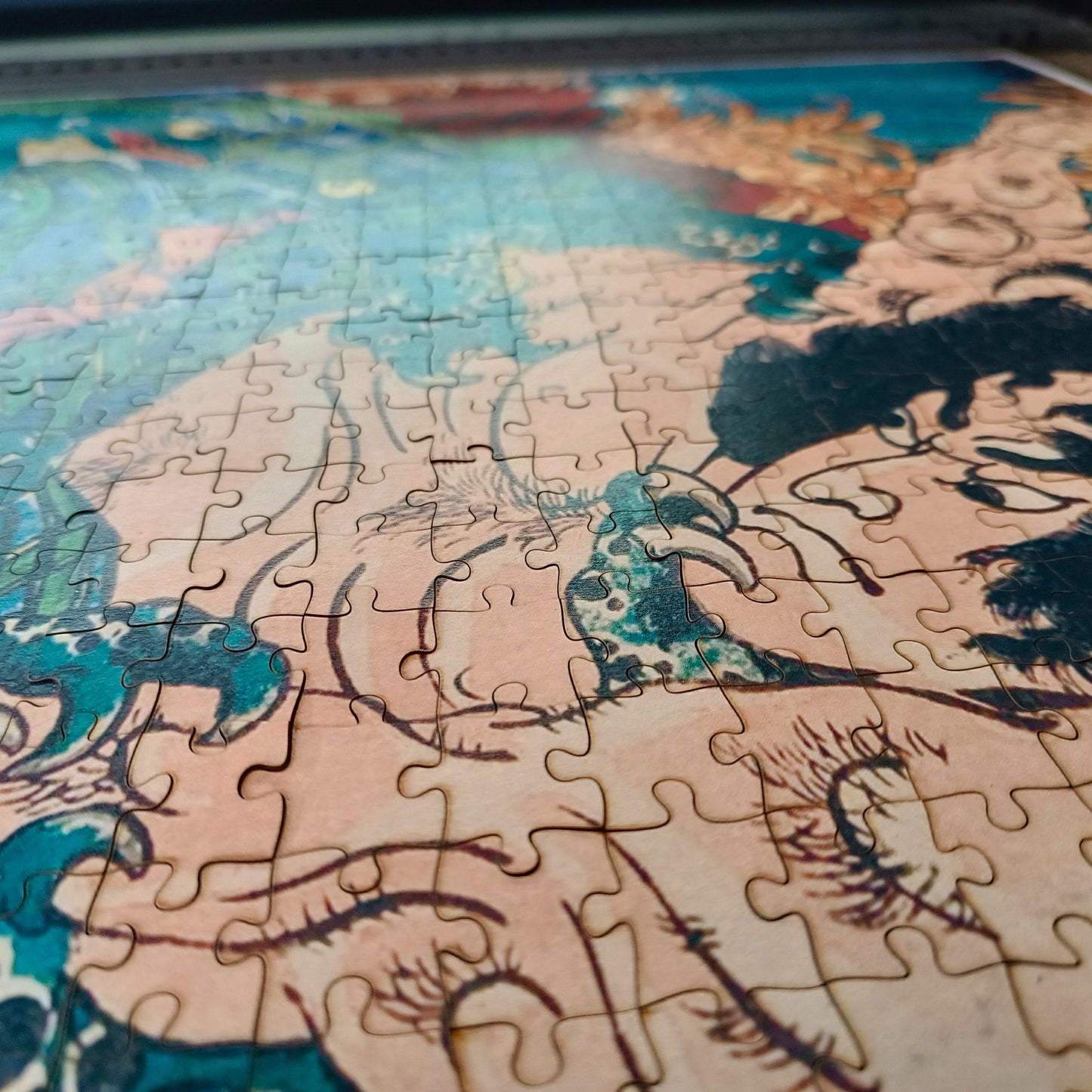
During assembly, the gun barrel becomes the organizing problem. The muzzle sits near the center of the composition, and the pieces around it are deceptively close in tone — dark grey, cool grey, shadowed blue. On a screen the barrel reads as a single shape. In wood, under UV printing, the gradations along its length become distinct. You find yourself sorting pieces you thought were identical. That's where the foreshortening actually lives, in the subtle shift from highlight to shadow that makes a flat surface read as depth.
🎁 Who Gets One of These
A few kinds of people buy this one, and they're not the same person.
✔️ The ukiyo-e collector who already owns prints — You know Yoshitoshi's late work. You've tracked his shift from graphic violence toward psychological complexity. Having this image in puzzle form is a different kind of time with it.
✔️ The art historian with a focus on East-West exchange — The foreshortening in this print is a specific, dateable moment of cross-cultural influence. Working through it piece by piece is a slow argument with the composition.
✔️ The person who visits museum Japanese galleries first — The Rijksmuseum holds a copy of this print. The Fitzwilliam does too. You've probably stood near one without knowing it.
✔️ The woodblock printing enthusiast who works with the medium — The UV-on-wood reproduction preserves color saturation that paper reproductions flatten. The original's palette reads differently here.
✔️ The gift-giver who wants something that requires an explanation — Yoshitoshi, censorship, a civil war, and a borrowed Western trick, all in one image. The story behind this piece is not short.
Works for Father's Day if he's the kind of father who reads about the Meiji Restoration on his own time. Strong birthday gift for anyone serious about Japanese art or art history. Meaningful anniversary gift between two people who collect deliberately.
🧩 Puzzle Specifications
✔️ Precision laser-cut wooden pieces
✔️ 3mm MDF core — rigid, warp-resistant, built to last
✔️ UV printing directly on wood — no paper laminate, no peeling
✔️ Traditional grid-cut design
✔️ Handcrafted wooden keepsake box included
✔️ Made to order — ships in 3–4 weeks
💎 Why This Puzzle Lasts
Wooden puzzles from most established brands run $300 to $500. The craft justifies it. WAWW gets to the same place differently: direct manufacturing, no wholesale chain, made to order with no warehouse sitting between the maker and the buyer. Same materials. Honest price.
The 3mm MDF core is what separates a wooden puzzle from a cardboard one over time. Cardboard warps, absorbs humidity, and loses its edge definition within a few years. MDF holds its shape. Pieces cut from it still click cleanly decades out, because the substrate hasn't shifted. UV printing goes directly onto that wood surface, no paper laminate between the ink and the material. Paper laminates yellow, peel at the corners, and separate from heat. Direct UV printing does none of those things, and for a print like this one, where color accuracy across the robe's white and blue matters, that stability is not a small thing.
The grid cut is traditional, no novelty shapes, no irregular silhouettes. Pieces find each other by color and pattern, the way puzzle solving is supposed to work. When you finish, the wooden keepsake box becomes a permanent part of the object — most people store the completed puzzle in it, or use the box alone on a shelf. Every puzzle is made to order, cut after you place it. The three-to-four-week lead time exists because nothing is warehoused. That's the model.
The 300-piece, 15"x23" starts at $115. The 1000-piece, 23"x31" runs $170.
🖼️ After You Finish It
Most people frame it. The keepsake box stays nearby, usually on a shelf or a desk, because it's too well made to throw out. The image draws questions from people who don't know it — the gun barrel first, then the robe, then someone asks who the warrior is. Yoshitoshi made this print in the middle of a war, dressed his subjects in historical costume to get past the censors, and borrowed a European spatial technique to make a 19th-century Japanese man aim a matchlock gun directly at anyone who looks. That's a longer conversation than most framed prints start.
⚠️ Important Notes
Puzzles may have light laser residue on the surface — a damp cloth handles it. There's a natural wood scent when the box first opens; it fades within a few days. Made-to-order production means your puzzle ships in 3–4 weeks. If anything arrives damaged, we replace or refund. No questions.