


Map of the Hawaiian Islands - Premium Wooden Puzzle
Map of the Hawaiian Islands - Premium Wooden Puzzle
- Regular price
- Price: $115.00
- Regular price
- List Price:
- Sale price
- Price: $115.00
- Unit price
- per
Key Features:
Key Features:
- Premium Quality: Crafted from durable 3mm (.14in) composite wood board for lasting enjoyment.
- Vibrant Imagery: High-resolution UV printing directly on the wood—no paper laminate—for stunning detail and vibrant colors.
- Eco-Conscious: Made with environmentally friendly materials.
- Heirloom Keepsake: Your puzzle arrives beautifully packaged in a handcrafted wooden box, perfect for gifting or storing your masterpiece.
Craftsmanship and Care:
Craftsmanship and Care:
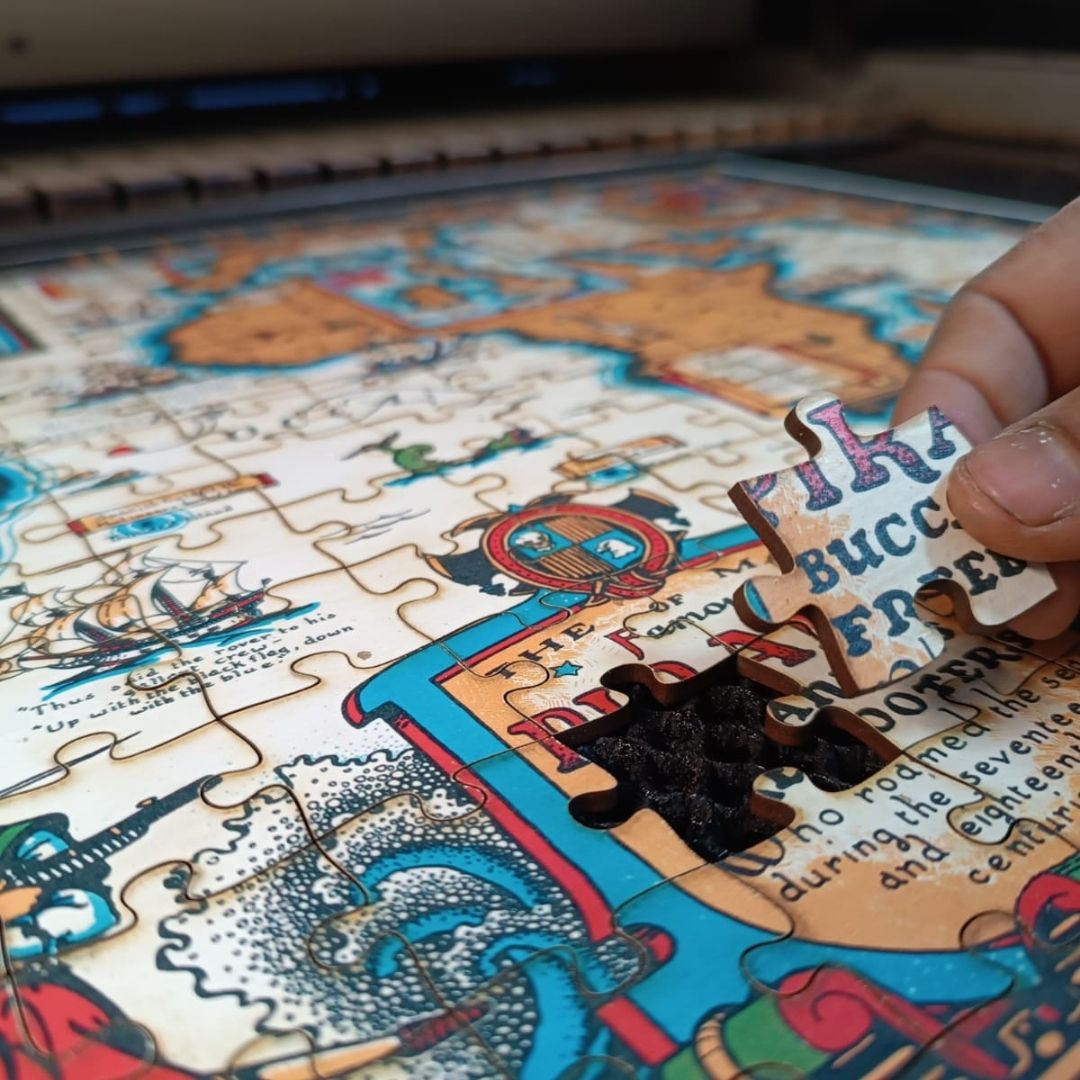
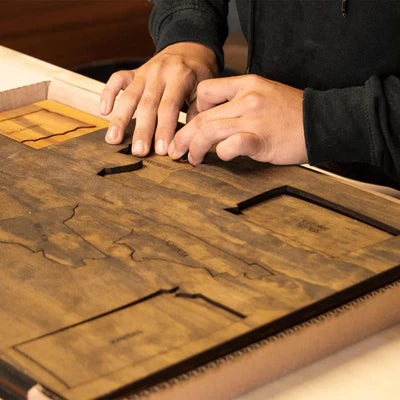
Experience the satisfying click of perfectly interlocking pieces. Our state-of-the-art laser cutting ensures precise fit and a smooth, seamless puzzle-solving experience. The perfect upgrade from cardboard without breaking the bank.
- Natural Laser Residue: A small amount of harmless black residue from the laser cutting process may be present. Simply wipe it away with a damp cloth.
- Hand-Finished Details: Each puzzle board, each wooden box are all carefully hand-stained, painted, and glued.
Satisfaction Guaranteed:
Satisfaction Guaranteed:
We are confident in the quality of our puzzles. If you are not completely satisfied, we offer a full refund or exchange.
PLEASE NOTE:
Each puzzle is crafted to make the most of your chosen size. Artwork may be subtly adjusted to meet our material and production standards while honoring the original work. Planning to frame yours? Email info@whatawoodwork.com for final measurements.
Couldn't load pickup availability
In stock
 PRODUCT DESCRIPTION
Map of the Hawaiian Islands by Ruth Taylor White — Wooden Jigsaw Puzzle
Ruth Taylor White visited Hawaii in 1931 and came back with something the Hawaii Tourist Bureau actually wanted: a map that got things wrong on purpose. Her "cartographs" weren't geographic documents. They were promotional tools dressed as maps, and the bureau knew it. Surfers appear where surfers actually surfed. Pineapples grow where pineapples actually grew. The coastlines, though, bent to the story the islands needed to tell.
📖 The Story Behind This Piece
White made her Hawaiian cartographs in the 1930s and 40s, at a moment when commercial air travel to the islands was still a decade away and tourism depended almost entirely on imagination. She produced individual maps for Hawaii, Maui, Oahu, and Kauai in collaboration with the Hawaii Tourist Bureau and the Honolulu Star-Bulletin, then brought the whole archipelago together in a single cohesive map published in 1935 in Our U.S.A.: A Gay Geography, a book she co-authored with her brother, journalist Frank J. Taylor. The islands on that map are populated with surfers, big-game fish, fields of sugar cane, and the small human figures that made her work feel more like a stage set than a chart.
White called her work "cartographs" and meant it as a distinction. Geographic accuracy wasn't the point. The belief behind every map she made was that a place could be communicated through its character rather than its coordinates. She wasn't illustrating Hawaii so much as arguing for a particular version of it: warm, abundant, a little theatrical. The Hawaii Tourist Bureau agreed. So did collectors for the next ninety years.
During assembly, the interior of Oahu becomes its own sorting problem. White's color fields are bold and readable from across a table, but within any single island, the illustrated figures — a surfer here, a fish there, a stand of pineapples — create small pools of visual density surrounded by flat color. On a digital screen, those figures read as decorative details. On a wood puzzle, printed directly onto the MDF with UV ink rather than transferred through paper laminate, the linework sits right at the surface. You can see the weight of the original brushstroke in a way a print-on-paper puzzle simply doesn't allow. The flat expanses of ocean between islands, meanwhile, are where the grid-cut geometry becomes almost meditative in its plainness. Two different solving experiences in the same puzzle.
🎁 Who Gets One of These
A specific kind of buyer finds this one. Here's who actually orders it.
✔️ The vintage map collector — already owns framed cartographic prints; White's Hawaiian series is genuinely collectible Hawaiiana, and a wooden puzzle version sits alongside that collection rather than below it.
✔️ The Hawaii-connected buyer — someone who lived on Oahu, honeymooned on Maui, or has family roots in the islands and wants a wall object that means something beyond decoration.
✔️ The 1930s design enthusiast — drawn to the era's commercial illustration style: bold outlines, flat color, figures that gesture at humor without committing to a joke.
✔️ The gift-giver with a specific person in mind — shopping for a retiring travel editor, a geography teacher who spent a sabbatical in Honolulu, or a parent who keeps saying they want to go back.
Works well as a retirement gift for anyone with a Hawaii chapter in their story, a milestone birthday for the map collector who has everything framed already, or a housewarming for someone who just moved back to the mainland.
🧩 Puzzle Specifications
✔️ Precision laser-cut wooden pieces
✔️ 3mm MDF core — rigid, warp-resistant, built to last
✔️ UV printing directly on wood — no paper laminate, no peeling
✔️ Traditional grid-cut design
✔️ Sizes: 15"x23", 18"x24", 23"x31"
✔️ Piece counts: 300–1000
✔️ Handcrafted wooden keepsake box included
✔️ Made to order — ships in 3–4 weeks
💎 Why This Puzzle Lasts
Museum-quality wooden puzzles from other makers run $300 to $500. WAWW puzzles run $115 to $170. The difference is direct manufacturing and no wholesale chain, not a shortcut in materials or cut quality. The math is straightforward.
The 3mm MDF core is what makes a wooden puzzle feel different the moment you pick up a piece. Cardboard compresses and warps; MDF holds its geometry under humidity and handling, so pieces click into place the same way on day one as they do years later when someone pulls the box out again. UV ink printed directly onto that wood surface bonds at a molecular level rather than sitting on top of a paper layer. No laminate means no peeling at the corners, no lifting after a decade on the wall, and no color shift from light exposure over time.
The laser cut follows a traditional grid pattern, which sounds simple but matters: pieces interlock with a satisfying mechanical click rather than the loose friction fit that plagues cheaper wooden puzzles. When the puzzle is done, it goes into a handcrafted wooden keepsake box sized to hold it, which means the box stays in the house as a permanent object rather than getting broken down for recycling. Every puzzle is made to order, cut after purchase, not pulled from warehouse inventory. The three-to-four-week production window is the cost of zero waste and a puzzle made for the person who ordered it.
The 300-piece, 15"x23" starts at $115. The 1000-piece, 23"x31" runs $160.
🖼️ After You Finish It
Most people frame it. UV printing directly on wood means the colors won't fade and the surface doesn't need protective glass to stay sharp. A standard wooden frame works. The 23"x31" size fits a frame you can find at any art supply store without custom cutting. White's cartographs were always meant to go on walls. A puzzle version just takes longer to get there.
⚠️ Important Notes
Puzzles may have light laser residue on the surface — a damp cloth handles it. There's a natural wood scent when the box first opens; it fades within a few days. Made-to-order production means your puzzle ships in 3–4 weeks. If anything arrives damaged, we replace or refund. No questions.