


The Adoration of the Shepherds - Premium Wooden Puzzle
The Adoration of the Shepherds - Premium Wooden Puzzle
- Regular price
- Price: $115.00
- Regular price
- List Price: $0.00
- Sale price
- Price: $115.00
- Unit price
- per
Key Features:
Key Features:
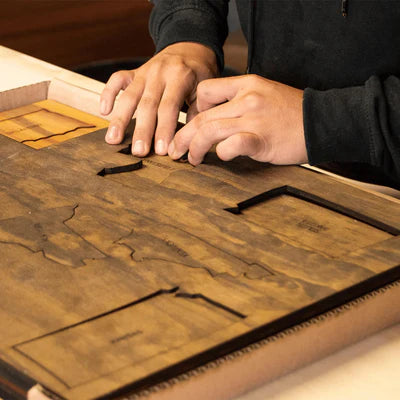
- Premium Quality: Crafted from durable 3mm (.14in) composite wood board for lasting enjoyment.
- Vibrant Imagery: High-resolution UV printing directly on the wood—no paper laminate—for stunning detail and vibrant colors.
- Eco-Conscious: Made with environmentally friendly materials.
- Heirloom Keepsake: Your puzzle arrives beautifully packaged in a handcrafted wooden box, perfect for gifting or storing your masterpiece.
Craftsmanship and Care:
Craftsmanship and Care:
Experience the satisfying click of perfectly interlocking pieces. Our state-of-the-art laser cutting ensures precise fit and a smooth, seamless puzzle-solving experience. The perfect upgrade from cardboard without breaking the bank.
- Natural Laser Residue: A small amount of harmless black residue from the laser cutting process may be present. Simply wipe it away with a damp cloth.
- Hand-Finished Details: Each puzzle board, each wooden box are all carefully hand-stained, painted, and glued.
Satisfaction Guaranteed:
Satisfaction Guaranteed:
We are confident in the quality of our puzzles. If you are not completely satisfied, we offer a full refund or exchange.
PLEASE NOTE:
Each puzzle is crafted to make the most of your chosen size. Artwork may be subtly adjusted to meet our material and production standards while honoring the original work. Planning to frame yours? Email info@whatawoodwork.com for final measurements.
Couldn't load pickup availability
In stock
 PRODUCT DESCRIPTION
The Adoration of the Shepherds by Guido Reni now in Wooden Jigsaw Puzzle form!
Reni was dying when he painted this. He left it unfinished in his studio in 1642, and the loose brushwork you see in the upper reaches of the canvas — the angels half-formed, the darkness barely held back — wasn't a stylistic choice. It was where his hand stopped. The National Gallery acquired it in 1957. Nearly five meters tall in person. The light in it still comes from the child.
📖 The Story Behind This Piece
Around 1640, Guido Reni began work on a second large-scale Adoration, likely for Prince Karl Eusebius von Liechtenstein. The first version had already gone to the Certosa di San Martino in Naples. In this one, a stable in Bethlehem holds its breath: shepherds crowd the frame, the Christ Child radiates the only light in the composition, and everything else — the faces, the straw, the edges of robes — falls away into a warm, painted dark. The night atmosphere isn't backdrop. It structures the whole painting.
By 1640, Reni had abandoned the smooth, polished finish that made him famous. His late works are rougher, faster, almost impatient. Some scholars read anxiety into it. Some read confidence. What's certain is that he stopped caring whether the paint showed. In the Adoration, the brushwork in the periphery is visible, almost gestural — a different kind of devotion than the careful, finished altarpieces of his earlier career.
The deep night tones of this painting do something specific in a wooden puzzle. UV printing on wood holds the warm golds and amber shadows without the slight sheen that paper laminate adds, so the gradients from the Christ Child's glow outward into darkness assemble in genuine tonal steps rather than a flat wash. The mid-tones around the shepherds' faces are where the work concentrates: pieces that look nearly identical in a pile separate clearly once you hold them, because the wood grain beneath the ink gives each one just enough texture to read by touch.
🎁 Who Gets One of These
A few specific people come to mind for this one.
✔️ The Baroque collector who's stood in front of a Reni at the National Gallery — You know the late brushwork in person. Rebuilding the Adoration piece by piece is a slower, closer version of that same attention.
✔️ The art historian who teaches 17th-century Italian painting — Reni left this unfinished. That fact is visible in the composition, and spending time with it in puzzle form makes the unfinished edges impossible to ignore.
✔️ The serious gift-giver at Christmas — The Nativity subject is specific and considered, not generic holiday. It's the kind of gift that signals you knew what the person actually cared about.
✔️ The museum member who has outgrown cardboard puzzles — You want something that stays out after it's done. The wooden keepsake box earns shelf space on its own.
✔️ The collector who already owns religious art — A Reni Adoration in puzzle form holds its own next to serious work. It doesn't look like a souvenir.
💎 Why This Puzzle Lasts
Wooden puzzle makers charging $300 to $500 are pricing honestly for what the craft costs. WAWW gets to the same materials and construction through direct manufacturing and made-to-order production, with no wholesale chain taking a cut in between. The difference shows up in the price, not the object.
The 3mm MDF core is what keeps pieces clicking cleanly years after the first assembly. Cardboard compresses at the joints over time; MDF doesn't, so the fit stays precise whether the puzzle is assembled once or a dozen times.
UV ink goes directly onto the wood surface, with no paper layer in between. Paper laminates peel at the edges eventually, especially in puzzle pieces that get handled repeatedly. On MDF, the ink bonds to the material itself, and the color holds without a glossy protective coat that would flatten the warm tonal range Reni built into this painting.
The laser-cut traditional grid produces pieces that lock positively into place. No ambiguous fits, no pieces that seem right until three moves later. Each connection is either correct or it isn't, which is the only kind of puzzle worth finishing.
The handcrafted wooden keepsake box ships as part of the object, not the packaging. Most people keep it. It sits on a shelf next to books or on a console, and it reads as a considered object even when the puzzle itself is framed or stored inside.
Made to order means your puzzle doesn't exist until you buy it. No warehouse inventory, no overrun stock. Production takes 3 to 4 weeks, and the wait is the reason the object arrives as something specific to your order rather than something pulled from a shelf.
The Adoration of the Shepherds has been in the National Gallery since 1957 and studied for longer than that. Reassembling it by hand is a different kind of looking.