


Unnatural Selection by Schachtzabel - Wooden Jigsaw Puzzle
Unnatural Selection by Schachtzabel - Wooden Jigsaw Puzzle
- Regular price
- Price: $115.00
- Regular price
- List Price: $0.00
- Sale price
- Price: $115.00
- Unit price
- per
Key Features:
Key Features:
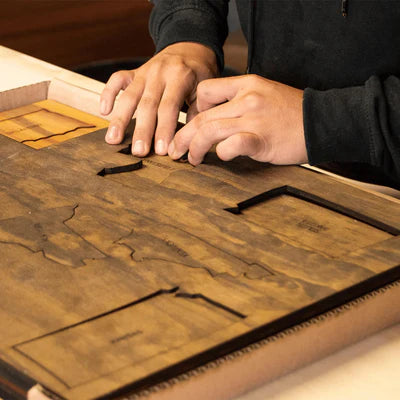
- Premium Quality: Crafted from durable 3mm (.14in) composite wood board for lasting enjoyment.
- Vibrant Imagery: High-resolution UV printing directly on the wood—no paper laminate—for stunning detail and vibrant colors.
- Eco-Conscious: Made with environmentally friendly materials.
- Heirloom Keepsake: Your puzzle arrives beautifully packaged in a handcrafted wooden box, perfect for gifting or storing your masterpiece.
Craftsmanship and Care:
Craftsmanship and Care:
Experience the satisfying click of perfectly interlocking pieces. Our state-of-the-art laser cutting ensures precise fit and a smooth, seamless puzzle-solving experience. The perfect upgrade from cardboard without breaking the bank.
- Natural Laser Residue: A small amount of harmless black residue from the laser cutting process may be present. Simply wipe it away with a damp cloth.
- Hand-Finished Details: Each puzzle board, each wooden box are all carefully hand-stained, painted, and glued.
Satisfaction Guaranteed:
Satisfaction Guaranteed:
We are confident in the quality of our puzzles. If you are not completely satisfied, we offer a full refund or exchange.
PLEASE NOTE:
Each puzzle is crafted to make the most of your chosen size. Artwork may be subtly adjusted to meet our material and production standards while honoring the original work. Planning to frame yours? Email info@whatawoodwork.com for final measurements.
Couldn't load pickup availability
In stock
 PRODUCT DESCRIPTION
Unnatural Selection: Emil Schachtzabel was a German civil servant who spent his spare hours cataloguing pigeons. Not the birds outside your window.
Birds with foot feathers fanning out like ballgowns, with throat pouches that inflate like small balloons, with head crests so extreme they obscure the bird's own vision. He published them all in 1906 in a volume called Illustriertes Prachtwerk sämtlicher Taubenrassen. Darwin had already used pigeons to explain natural selection. Schachtzabel was documenting what humans had done to them since.
📖 The Story Behind This Piece
Published in Würzburg around 1906, Illustriertes Prachtwerk sämtlicher Taubenrassen ran to 100 chromolithographic plates. The plates were based on watercolors by Anton Schöner, a specialist in natural history illustration. Schöner did not soften the exaggerations. A breed with a pouch like a bladder is shown with a pouch like a bladder. Feathered feet that would make flight nearly impossible are rendered feather by feather. The whole book functions as a catalog of what selective breeding, pushed far enough, actually produces — which is often something stranger than fiction.
Schachtzabel was not a painter. He was the president of the Federation of German Poultry Breeders, a man whose expertise was administrative and organizational. What he contributed was the conviction that these birds deserved rigorous, comprehensive documentation — every known breed, rendered at the same standard, in a single authoritative volume. Without that conviction, Schöner's watercolors stay scattered. With it, the book becomes a scientific reference that Darwin scholars still cite more than a century later.
Assembly on a chromolithograph rewards close attention in a way photography rarely does. The backgrounds in Schöner's plates shift from warm ochre to deep slate depending on the bird's plumage, and those transitions become visible only in physical pieces, where the UV ink sits directly on the wood grain rather than behind a layer of paper laminate. At some point you'll be sorting a cluster of pieces that are almost the same warm gray, and you'll realize you're looking at the underside of a wing, and that the gray has a dozen distinct values you hadn't noticed in the full image.
🎁 Who Gets One of These
A few types of people keep coming back to this one specifically.
✔️ The natural history collector with a soft spot for Victorian scientific illustration — Schöner's chromolithographs sit in the same tradition as Gould's bird plates and Haeckel's radiolarians. Same era, same commitment to rendering what classification actually looks like.
✔️ The Darwin reader who got deep into the pigeon chapters — Chapter one of On the Origin of Species runs almost entirely on pigeon breeding as its central example. Schachtzabel's book is what that argument looks like made visible.
✔️ The ornithologist who's tired of gifts that are just bird-themed — Chromolithographic accuracy at the breed level. Not a silhouette, not a watercolor robin on a mug. Something with real specificity.
✔️ The art history person whose interest runs toward scientific illustration and public domain archives — The Public Domain Review featured this work in its Unnatural Selection collection. If that sentence means something to you, you already know why this image works.
✔️ The gift-giver who needs something substantive for someone who has opinions about things — A handcrafted wooden box, a real historical artifact, a subject with genuine intellectual weight. Nothing about it is generic.
Works well as a birthday gift for anyone whose bookshelves include natural history, or as a holiday gift for the person who already owns everything they need. The subject matter is specific enough that getting it right signals real attention.
🧩 Puzzle Specifications
✔️ Precision laser-cut wooden pieces
✔️ 3mm MDF core — rigid, warp-resistant, built to last
✔️ UV printing directly on wood — no paper laminate, no peeling
✔️ Traditional grid-cut design
✔️ Sizes: 15"x23", 18"x24", 23"x31"
✔️ Piece counts: 300–1000
✔️ Handcrafted wooden keepsake box included
✔️ Made to order — ships in 3–4 weeks
💎 Why This Puzzle Lasts
Most wooden puzzle makers charge $300–$500. The craft justifies it. WAWW gets there differently: direct manufacturing, no wholesale chain, made to order in small runs. Same materials, no middleman markup. The price difference is structural, not a corner cut somewhere.
The core is 3mm MDF, which is rigid in a way cardboard simply cannot sustain. Cardboard absorbs humidity and warps at the edges; MDF doesn't. A puzzle built on this core fits together the same way on the hundredth assembly as it did on the first. UV printing bonds ink directly to the wood surface, which means no paper laminate to bubble, peel, or yellow over years. The color you see now is the color it holds.
The cut is a traditional grid, which means pieces interlock cleanly and stay where you put them. No novelty shapes, no pieces that look like they fit but don't. The wooden keepsake box is built to the same standard as the puzzle itself — most people store the finished pieces in it, and the box stays out. Made to order means no warehouse, no sitting in a stack for months. Your puzzle is cut after you order it, which is part of why the quality is consistent.
— the birds are familiar enough to recognize as pigeons and strange enough that something feels off. That question is a short road to Schachtzabel, to Darwin, to 1906 Würzburg, to a civil servant who thought the pigeon fancy deserved a definitive illustrated record. The conversation goes further than you'd expect.