


Whimsical Dinner by Kiyochika - Premium Wooden Jigsaw Puzzle
Whimsical Dinner by Kiyochika - Premium Wooden Jigsaw Puzzle
- Regular price
- Price: $115.00
- Regular price
- List Price: $0.00
- Sale price
- Price: $115.00
- Unit price
- per
Key Features:
Key Features:
- Premium Quality: Crafted from durable 3mm (.14in) composite wood board for lasting enjoyment.
- Vibrant Imagery: High-resolution UV printing directly on the wood—no paper laminate—for stunning detail and vibrant colors.
- Eco-Conscious: Made with environmentally friendly materials.
- Heirloom Keepsake: Your puzzle arrives beautifully packaged in a handcrafted wooden box, perfect for gifting or storing your masterpiece.
Craftsmanship and Care:
Craftsmanship and Care:
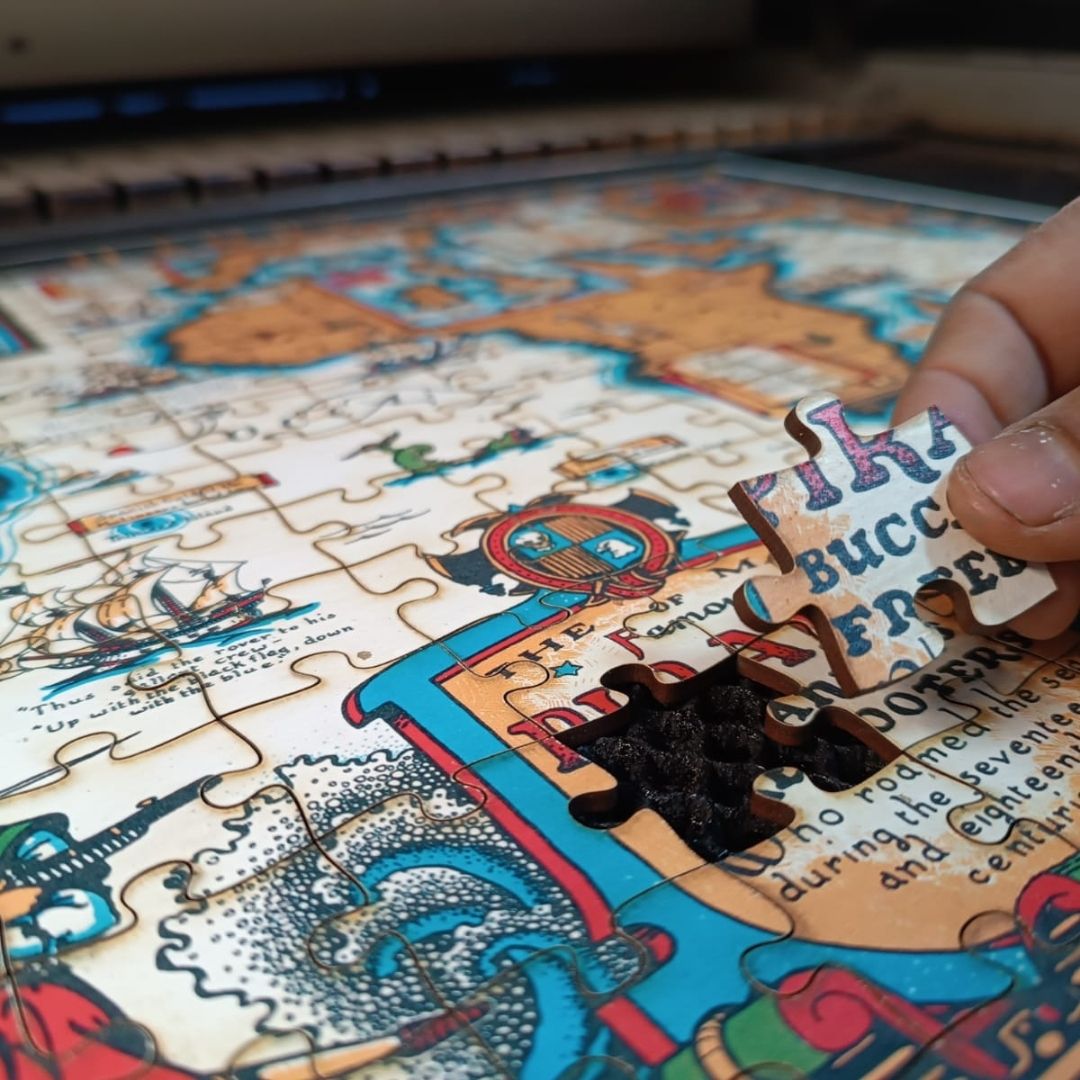
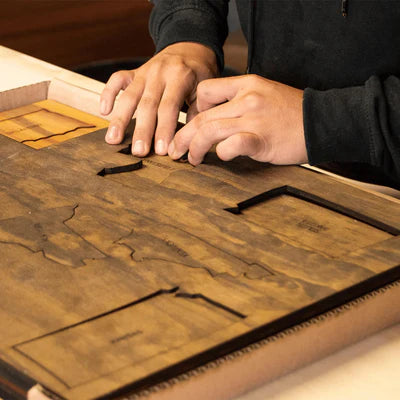
Experience the satisfying click of perfectly interlocking pieces. Our state-of-the-art laser cutting ensures precise fit and a smooth, seamless puzzle-solving experience. The perfect upgrade from cardboard without breaking the bank.
- Natural Laser Residue: A small amount of harmless black residue from the laser cutting process may be present. Simply wipe it away with a damp cloth.
- Hand-Finished Details: Each puzzle board, each wooden box are all carefully hand-stained, painted, and glued.
Satisfaction Guaranteed:
Satisfaction Guaranteed:
We are confident in the quality of our puzzles. If you are not completely satisfied, we offer a full refund or exchange.
PLEASE NOTE:
Each puzzle is crafted to make the most of your chosen size. Artwork may be subtly adjusted to meet our material and production standards while honoring the original work. Planning to frame yours? Email info@whatawoodwork.com for final measurements.
Couldn't load pickup availability
In stock
 PRODUCT DESCRIPTION
A Whale and Three Fish Sitting Down to a Formal Dinner of Russian sailors — Wooden Jigsaw Puzzle
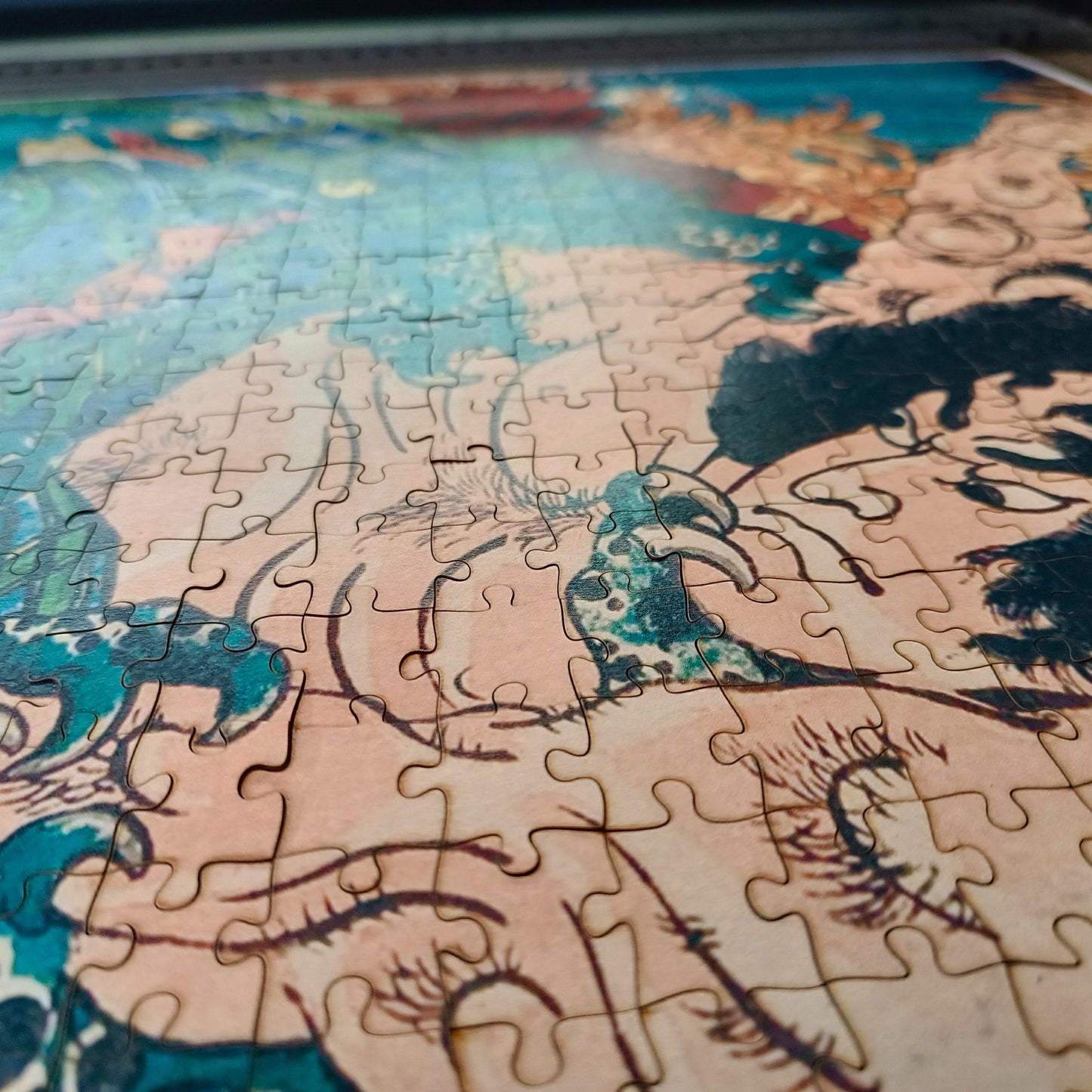
Japan won the Battle of Tsushima in May 1905, sinking or capturing nearly the entire Russian Baltic Fleet. Kiyochika was already ready with his response: a woodblock print showing a whale and three fish seated at a formal dinner table, eating Russian sailors. The series was called Long Live Japan: One Hundred Victories, One Hundred Laughs. He made exactly what the title promised.
📖 The Story Behind This Piece
Kiyochika made this print around 1904 or 1905, inside a propaganda series commissioned to document Japan's victories in the Russo-Japanese War through satire rather than heroism. The whale and fish are the Japanese naval forces. The sailors are the meal. What makes it strange is the formality: white tablecloth, proper seating, the full apparatus of a dignified dinner. The humor is merciless, and it was designed to be. The original is held today at the Library of Congress, donated in 1906 by journalist Crosby Stuart Noyes.
Kiyochika spent his career working in ukiyo-e woodblock at a moment when the form was under pressure from Western influence and photographic media. He didn't abandon traditional technique so much as bend it toward commentary. By the time of the Russo-Japanese War, he had already spent decades using the woodblock print to record Tokyo's transformation under the Meiji government. The propaganda series was a late-career pivot toward something more pointed. He understood that satire could travel farther than a battle painting.
During assembly, the tablecloth presents an early problem. Large sections of white and pale ivory break into pieces that all look nearly identical in isolation. Then a hand emerges from the edge of one piece, a collar from another, and suddenly the sailors come into focus from the negative space around them. UV printing directly on the MDF surface means the fine line work of the woodblock style holds at piece edges without bleeding or softening. In a digital reproduction, those lines read as detail. In the puzzle, they become the thing you're actually solving.
🎁 Who Gets One of These
A specific kind of collector buys this, and they tend to find it rather than search for it.
✔️ The Japanese woodblock collector who already owns Hiroshige and Hokusai prints — Kiyochika is the next name on that shelf, and his Meiji-era political prints are considerably harder to find than his landscapes.
✔️ The military history reader who knows the Russo-Japanese War as the first major defeat of a European power by an Asian nation — Tsushima changed the calculations of every navy in the world. Kiyochika captured the Japanese public's reaction the same week it happened.
✔️ The museum-going partner who already owns two Kiyochika reproductions and needs a third thing for the wall — a framed puzzle of this print is not a reproduction. It's a different object entirely.
✔️ The political cartoonist or graphic designer who studies visual propaganda seriously — the formal dinner conceit is a masterclass in how to frame dominance as comedy.
✔️ The gift-buyer who needs something for a Japan history enthusiast and has already given every coffee table book — a made-to-order wooden puzzle of a Library of Congress print is not a thing most people have encountered.
Strong occasions: birthdays for history readers, Father's Day for the dad who has an opinion about the Meiji period, and gift-giving for anyone who collects Japanese prints. Skip it as a general "art lover" gift; the subject matter is specific enough that the right person will recognize it immediately and the wrong person won't know what they're looking at.
🧩 Puzzle Specifications
✔️ Precision laser-cut wooden pieces
✔️ 3mm MDF core — rigid, warp-resistant, built to last
✔️ UV printing directly on wood — no paper laminate, no peeling
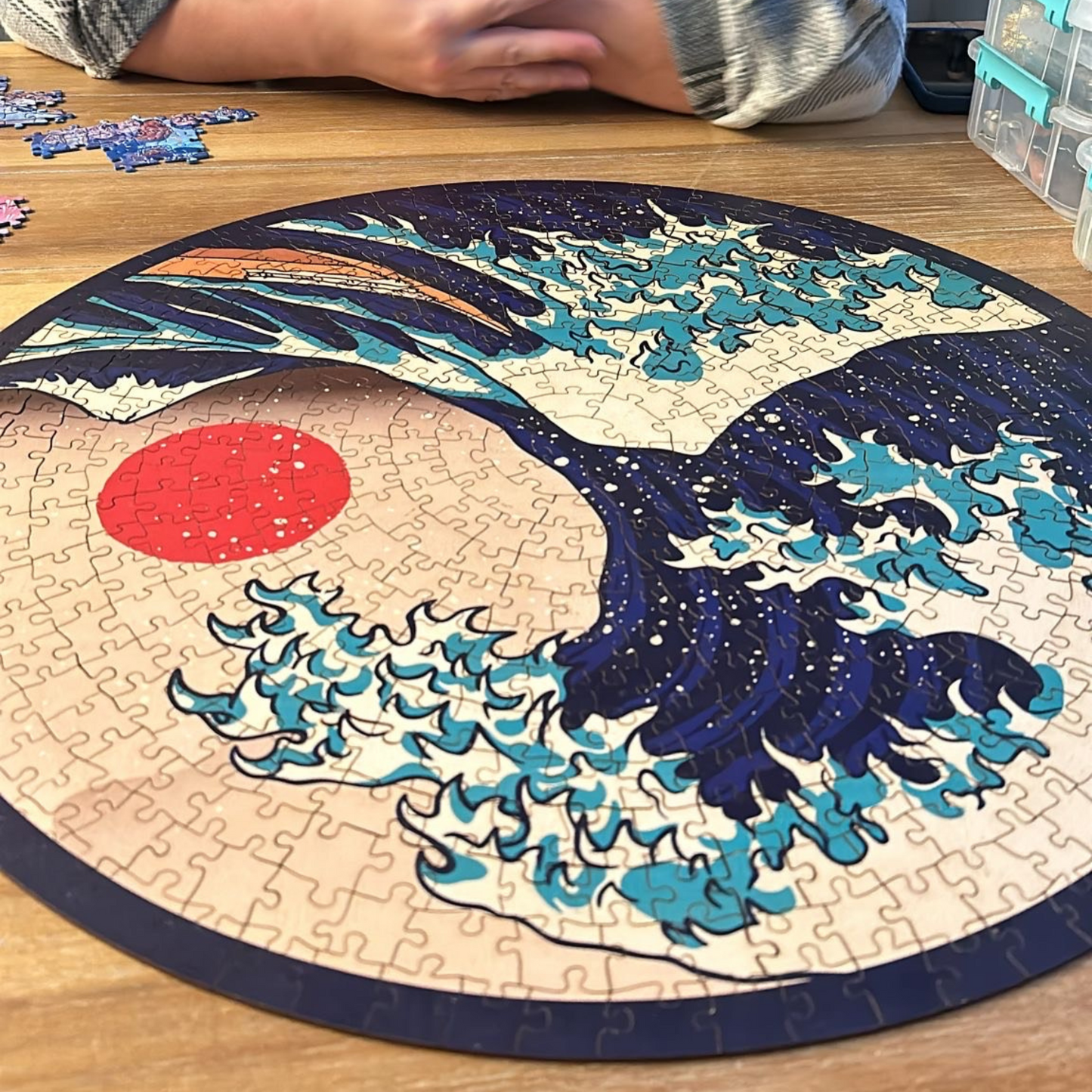
✔️ Traditional grid-cut design
✔️ Handcrafted wooden keepsake box included
✔️ Made to order — ships in 3–4 weeks
💎 Why This Puzzle Lasts
Most wooden puzzle makers charge $300 to $500. The craft justifies it. WAWW gets to $115–$170 through direct manufacturing and no wholesale chain. Same materials, no middleman markup.
The 3mm MDF core is what keeps a puzzle worth keeping. Cardboard compresses at the joints over time; pieces start fitting loosely, then not at all. MDF holds its shape, so the puzzle you assemble in year one fits exactly the same way in year ten. The UV ink goes directly into the wood surface rather than onto a paper layer bonded over it. No paper means no peeling at piece edges, and no laminate means the color you see now is the color you see in twenty years.
The traditional grid cut feels cleaner than novelty-shape cutting because every piece connects with the same mechanical certainty. You feel the fit before you see it. The wooden keepsake box ships as part of the object, not as packaging to be discarded; most buyers store the finished puzzle in it or keep it on a shelf after framing. Made-to-order means no warehouse stock, no overproduction, and a puzzle built specifically after you place the order. The three-to-four-week lead time is a function of that process.